The Reality of Local Search Visibility
Securing a prominent position in local search results is no longer as simple as creating a profile and waiting for customers to call. The digital landscape has evolved significantly.
Google Business Profile has become the central pillar of local search engine optimization. When optimized correctly, it acts as a direct acquisition channel for high intent clientele.
However, many businesses struggle to break into the highly coveted Local Pack. They watch as competitors with seemingly inferior services capture the majority of local search traffic.
If your Google Business Profile is not ranking, the issue is rarely a single catastrophic error. Instead, it is usually a combination of strategic misalignments, technical oversights, and a failure to demonstrate authoritative value to the search algorithm.
This comprehensive guide examines the foundational mechanics of local search algorithms. We will explore the precise reasons why your profile might be suppressed in the rankings.
We will also provide strategic methodologies to align your digital presence with modern search standards, including Answer Engine Optimization.
Also Read: What Is Google Business Profile?
Understanding the Local Search Algorithm
Before diagnosing why a profile is failing to rank, it is crucial to understand how search algorithms evaluate local entities. Google does not rank businesses based on the quality of their physical services.
Algorithms evaluate digital signals to determine which business is the most appropriate recommendation for a specific user query. The local algorithm operates on three primary pillars.
Relevance to the Search Query
Relevance measures how closely a local business profile matches what the user is searching for. If a user searches for a corporate law firm, the algorithm filters out family law practices or general business consultants.
Google determines relevance through your primary category, secondary categories, business description, and the content on your linked website.
Distance and Proximity
Distance calculates how far each potential search result is from the location term used in a search. If the user does not specify a location, Google calculates distance based on what is known about their current location.
Proximity is one of the strongest ranking factors, and it is largely out of your direct control. However, establishing strong local relevance can help you rank across a wider geographic radius.
Prominence and Authority
Prominence refers to how well known a business is in the offline and online world. Some places are more prominent in the offline world, such as famous museums or landmark hotels, and search results try to reflect this.
In the digital ecosystem, prominence is built through external signals. This includes the quantity and quality of backlinks pointing to your website, local citations, and the volume and score of your customer reviews.
Foundational Setup and Technical Errors
The most common reason a Google Business Profile fails to rank is incomplete or inaccurate foundational data. Search algorithms prioritize certainty.
If the algorithm finds conflicting information about your business across the web, it loses confidence in your entity. A lack of algorithmic confidence directly results in suppressed rankings.
Inaccurate or Missing Categories
Your primary business category is the single most influential factor in your local ranking potential. Selecting a broad or slightly inaccurate primary category prevents you from appearing for highly specific, high intent searches.
Many businesses select a primary category that describes what their business is, rather than what it specifically provides. You must select the most specific primary category available that accurately describes your core operation.
Additionally, failing to utilize secondary categories leaves valuable search visibility on the table. Secondary categories help the algorithm understand the full breadth of your service offerings.
Inconsistent Name, Address, and Phone Number
Consistent data is the bedrock of local search authority. Your business Name, Address, and Phone Number must be exactly the same across every digital platform.
If your Google Business Profile lists your address as Suite 100, but your website says Ste 100, and your local directory listings say Unit 100, this creates algorithmic confusion.
Search engines aggregate data from thousands of sources to verify your existence. Inconsistent data dilutes your digital footprint and prevents you from building the necessary prominence to rank in the Local Pack.
Keyword Stuffing in the Business Name
A very common and highly penalized tactic is stuffing keywords into the official Google Business Profile name. Adding terms like "Best Web Developer" or your city name to your actual business name violates guidelines.
While this tactic may yield a temporary spike in visibility, it almost always leads to a hard algorithmic penalty or a manual profile suspension.
Your profile name must reflect your actual, legally registered business name as it appears on your physical signage, official website, and legal documents.
How to Create a Google Business Profile in India Step by Step
The Impact of E-E-A-T on Local Rankings
Experience, Expertise, Authoritativeness, and Trustworthiness play a critical role in modern search visibility. Google wants to recommend businesses that represent the highest quality and safety for its users.
Establishing E-E-A-T is not just for organic website rankings. It heavily influences how your Google Business Profile performs.
Demonstrating Experience and Expertise
You must prove to the algorithm that your business possesses deep expertise in its field. This is achieved by thoroughly detailing your services within the profile.
Instead of simply listing a service, provide comprehensive descriptions, pricing structures where appropriate, and clear expectations.
Linking your profile to a highly authoritative website that contains in-depth, expertly written content further solidifies this signal. The algorithm connects the expertise on your website directly to your local profile.
Building Authoritativeness and Trustworthiness
Trust is primarily built through third party validation. In the context of a Google Business Profile, this means reviews and external mentions.
A profile with very few reviews, or a history of unaddressed negative reviews, signals a lack of trustworthiness. The algorithm is hesitant to rank a business that does not have a proven track record of customer satisfaction.
Furthermore, having your business mentioned by authoritative local publications or industry specific directories significantly boosts your prominence and trustworthiness scores.
Review Management and Algorithmic Engagement
Reviews are not just digital word of mouth. They are a massive ranking factor and a critical component of local search optimization. How you handle your review ecosystem directly dictates your ranking ceiling.
The Velocity and Recency of Reviews
A business with one hundred reviews from three years ago will often be outranked by a business with thirty reviews gathered consistently over the last three months.
Search algorithms value recent data. A steady, ongoing velocity of incoming reviews tells the algorithm that your business is currently active, popular, and trusted.
Businesses that fail to rank often suffer from stagnant review profiles. You must implement a structured, professional protocol to request reviews from satisfied clients at the culmination of a project or service.
Strategic Review Responses
Failing to respond to reviews is a missed opportunity for both customer service and search optimization. The algorithm monitors your engagement with your profile.
When you reply to reviews, you signal active management and dedication to client satisfaction. Furthermore, your replies offer an opportunity to naturally integrate semantic variations of your core services.
However, you must avoid aggressive keyword stuffing in your responses. A professional, contextual reply that mentions the specific service provided reinforces your relevance for those terms.
The Power of Keywords in Customer Reviews
When your clients naturally include your target keywords in their reviews, it provides a massive boost to your relevance for those terms.
If a user searches for digital transformation services, a profile with multiple reviews praising their digital transformation services will rank highly.
While you cannot dictate exactly what a client writes, you can guide them. When requesting a review, politely ask them to mention the specific project or service you delivered for them.
Optimizing Profile Content and Engagement
A static Google Business Profile will steadily lose ground to active, dynamic competitors. Google provides numerous tools within the profile to engage with potential customers. Utilizing these tools signals to the algorithm that your profile is a valuable, up to date resource.
Strategic Use of Google Posts
Google Posts function similarly to micro blog updates directly on the search engine results page. Businesses that do not utilize this feature miss a critical opportunity to capture attention and drive conversions.
Publishing regular updates regarding new services, strategic insights, or company news keeps your profile fresh.
These posts do not necessarily provide a direct algorithmic ranking boost, but they significantly increase click through rates and user engagement metrics, which indirectly influence rankings.
Optimizing Visual Assets
Profiles with a high volume of professional, high resolution images receive significantly more engagement than profiles with minimal or poor quality photos.
You must consistently upload authentic photos of your work, your team, and your operational environment. Avoid using stock photography, as algorithms can detect unoriginal images.
Ensure your images are properly compressed and clearly depict the premium nature of your services. High quality visual assets build immediate trust with prospective clients browsing the search results.
Managing the Q&A Section
The Questions and Answers section on your profile is a highly underutilized feature. Anyone can ask a question, and anyone can answer it.
If you leave this section unmanaged, competitors or disgruntled individuals can provide inaccurate information about your business.
A proactive strategy involves seeding your own Q&A section. Identify the most common questions prospective clients ask during initial consultations, and publish both the questions and the authoritative answers directly to your profile.
Answer Engine Optimization for Local Business
The landscape of search is rapidly shifting toward generative AI and answer engines. Users are increasingly asking complex, conversational questions rather than typing fragmented keywords.
Optimizing your Google Business Profile for Answer Engine Optimization is essential for future proofing your visibility.
Structuring Data for AI Consumption
Generative AI platforms rely on structured, clear, and highly specific data to formulate answers. If your profile and linked website contain vague or generic information, the AI will bypass you in favor of a clearer source.
You must ensure that all data points on your profile are exhaustively filled out.
Your service lists must be comprehensive, and your business description should read like a definitive, factual summary of your capabilities and market positioning.
How to Grow Your Business on Google: The Ultimate 2026 Digital Strategy
Aligning with Conversational Search Queries
Voice search and AI queries often begin with who, what, where, when, or why. Your digital presence must be optimized to answer these long tail, conversational queries.
By detailing specific solutions to complex problems within your profile and your website, you increase the likelihood of being cited as the authoritative source by an AI overview.
This requires a shift from focusing solely on high volume keywords to focusing on semantic relevance and deep topic authority.
The Influence of Your Linked Website
Your Google Business Profile does not exist in a vacuum. It is intrinsically tethered to the website you link to it. The SEO health of your website directly impacts the ranking capability of your local profile.
Local Landing Page Authority
If you link your profile to a homepage that lacks clear information about your location or core services, your profile will struggle to rank.
The linked page must be highly optimized for your target geography and primary service category.
The content on the page must reinforce the exact data present on your Google Business Profile. This includes matching NAP data, embedded maps, and comprehensive service details that mirror your profile categories.
Technical Performance and User Experience
A website that loads slowly, is difficult to navigate on a mobile device, or lacks clear security protocols will damage your overall digital authority.
Google evaluates the user experience of the website linked to your profile. If users click from your profile to your website and immediately bounce back to the search results due to poor performance, it sends a negative signal.
Premium website architecture, fast loading times, and a frictionless user journey are mandatory requirements for supporting a high ranking local profile.
Common Reasons for Profile Suspensions
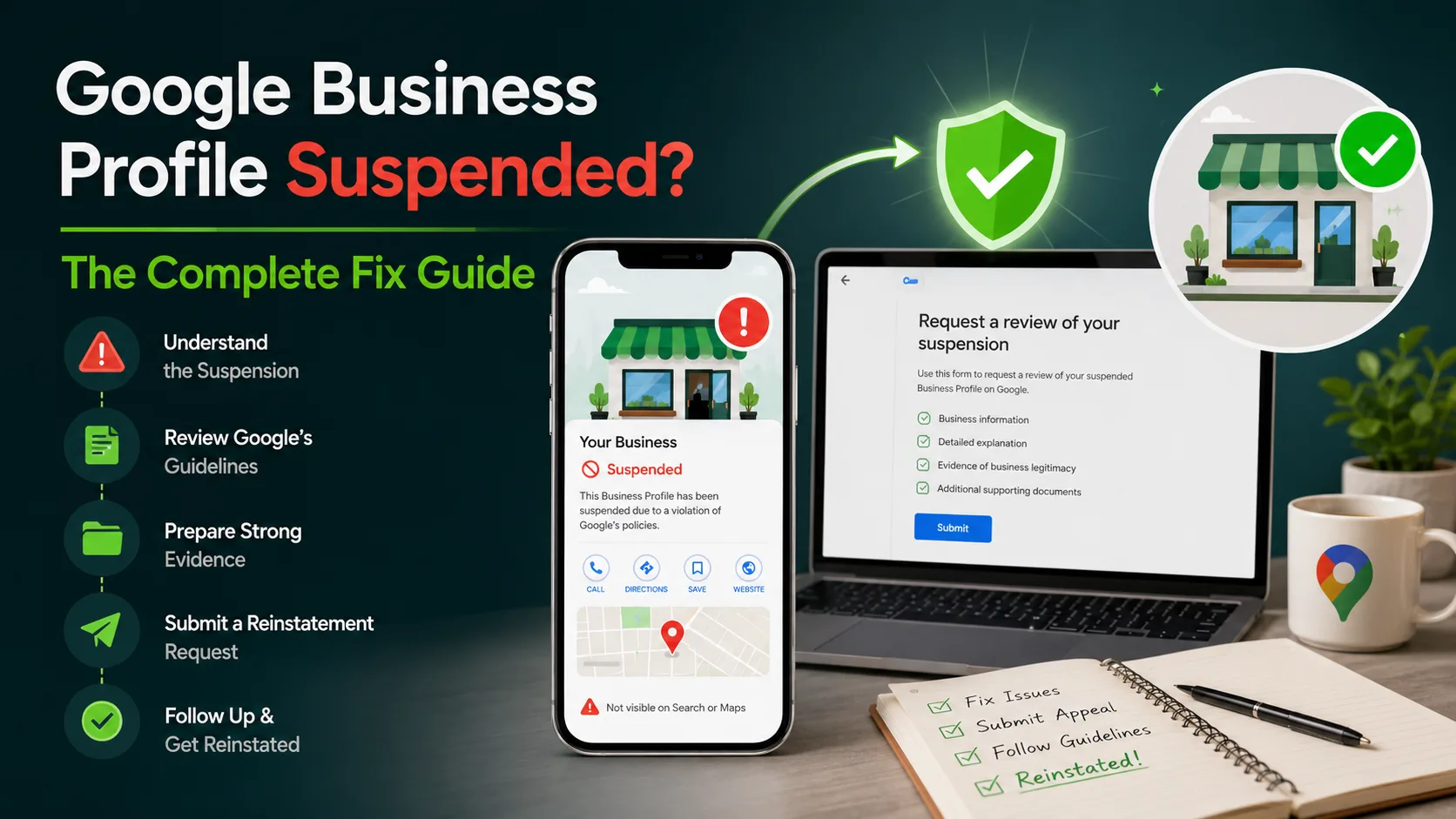
Sometimes a profile is not just failing to rank it has been entirely removed from the search ecosystem. Google enforces strict guidelines, and violations result in immediate suspensions.
Soft vs Hard Suspensions
A soft suspension typically means your profile is unverified. You lose the ability to manage the profile, but it may still appear in search results, often in a diminished capacity.
A hard suspension means your profile is completely removed from Google Search and Google Maps. This usually occurs due to severe guideline violations, such as operating a fake location or engaging in deceptive practices.
Recovering from a hard suspension requires a formal reinstatement request and proof of legitimate business operations.
Keyword Stuffing and Multiple Listings
As mentioned earlier, altering your business name to include search terms is a primary trigger for suspensions.
Another common violation is creating multiple Google Business Profiles for the same physical location or service area in an attempt to manipulate rankings.
Google algorithms are highly adept at identifying redundant entities. Attempting to game the system with multiple listings will ultimately result in the suppression or deletion of all associated profiles.
Effective vs Ineffective GBP Strategies
To clearly illustrate the difference between a high performing profile and a suppressed profile, review the following comparative data.
| Strategy Component | Ineffective Strategy | Premium Strategic Approach |
| Primary Category | Broad selection (e.g., Business) | Hyper specific selection (e.g., Software Company) |
| Profile Name | Keyword stuffed (e.g., Best SEO Agency) | Legally registered business name |
| Review Management | Ignored or automated generic replies | Custom, contextual replies acknowledging specific projects |
| Image Assets | Stock photos or no uploads | High resolution, authentic images of operations and results |
| Website Link | Slow, generic homepage | High performance, locally optimized service landing page |
| Ongoing Updates | Profile left dormant after creation | Weekly strategic updates utilizing Google Posts |
Elevate Your Digital Authority
Achieving dominance in local search requires far more than basic profile setup. It demands a rigorous, analytical approach to search engine algorithms, consistent data management, and the execution of high end digital strategies.
Learn More About Google My Business
When your digital presence is architected correctly, it transitions from a static listing into a powerful engine for premium client acquisition.
If your organization requires a sophisticated approach to search visibility, Answer Engine Optimization, and comprehensive digital transformation, you need a partner capable of executing at the highest level.
Contact TenG Spectrum to discuss how our strategic web development and advanced SEO solutions can position your brand as the undeniable authority in your market.
Frequently Asked Questions
Find quick answers to common questions about this topic