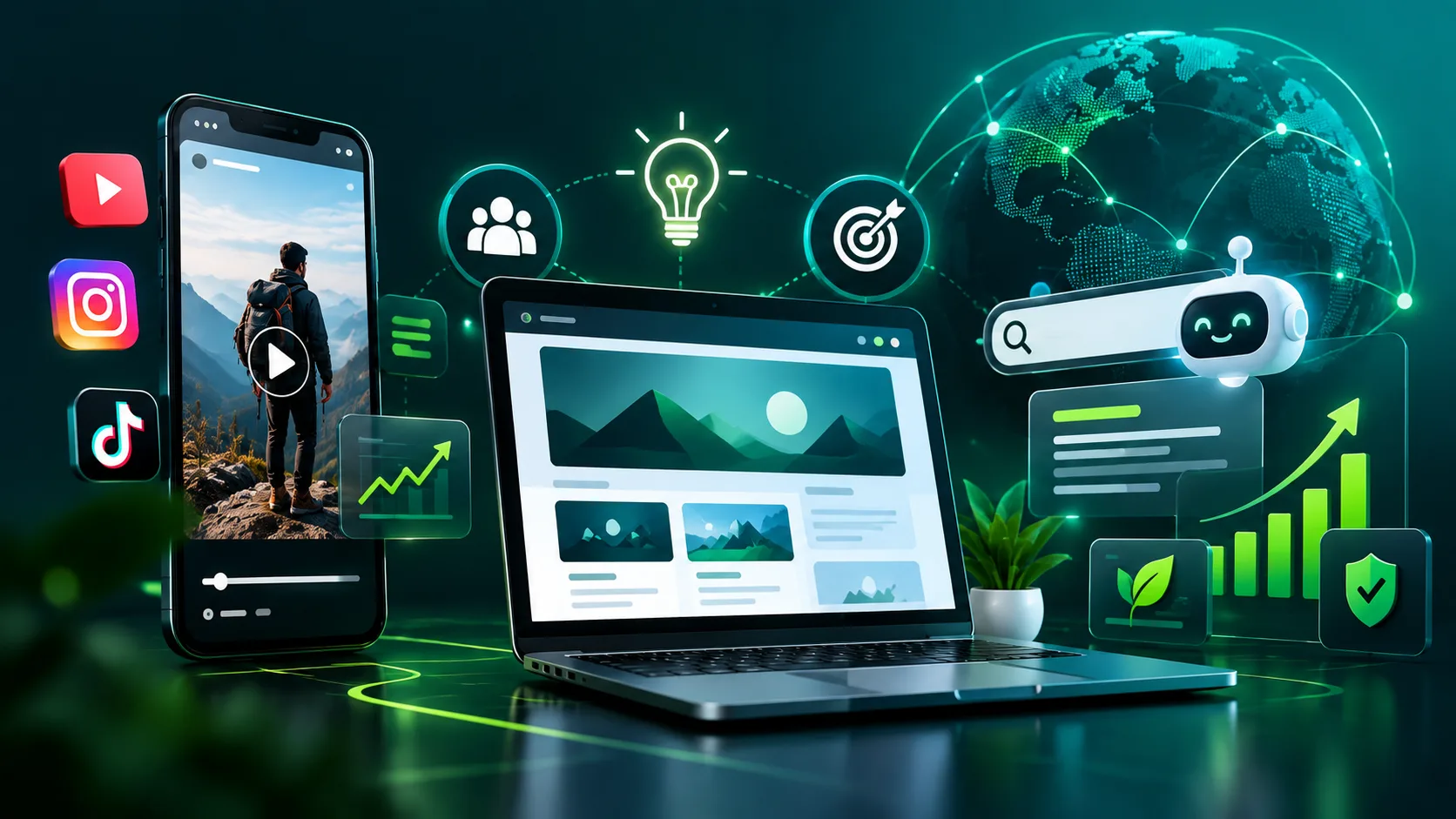
In the current digital ecosystem, the debate between prioritizing a website or a social media presence has shifted from a matter of convenience to a fundamental question of business sovereignty. As we navigate 2026, the complexity of online interactions and the evolution of search engines have redefined what it means to "exist" online.
For many startups and established enterprises, the allure of social media is undeniable. It offers immediate access to billions of users, low entry barriers, and a fast-paced environment for brand awareness. However, relying solely on these platforms introduces significant structural risks that can jeopardize long-term stability.
A professional website remains the only digital asset where a brand exercises absolute control over its narrative, data, and user experience. This guide provides a comprehensive analysis of how these two pillars of digital marketing function, why the "rented land" of social media is insufficient as a standalone strategy, and how a custom-built website serves as the engine for conversion and credibility.
Defining the Roles: Discovery versus Conversion
Top 5 Reasons Why Cheap Website Development is a Mistake
To build a sustainable digital strategy, one must understand that websites and social media serve distinct stages of the customer journey. Misaligning these roles often leads to high engagement metrics that fail to translate into actual revenue.
Social Media: The Discovery Engine
Social media platforms are designed for discovery and engagement. They function as the "top-of-funnel" mechanism where potential customers first encounter a brand through viral content, targeted advertisements, or community discussions.
The primary strength of social media lies in its ability to push content to users based on behavioral algorithms. In 2026, these algorithms are highly sophisticated, utilizing real-time interest mapping to put your brand in front of new eyes.
The Website: The Conversion Headquarters
Conversely, a website is where the "consideration" and "decision" phases of the buyer's journey occur. It is a controlled environment designed to facilitate specific actions, such as booking a consultation, purchasing a product, or downloading a technical whitepaper.
A website acts as the final destination. While social media creates the spark of interest, the website provides the depth of information and the secure infrastructure required to finalize a professional relationship.
The "Rented Land" Risk: Understanding Algorithmic Vulnerability
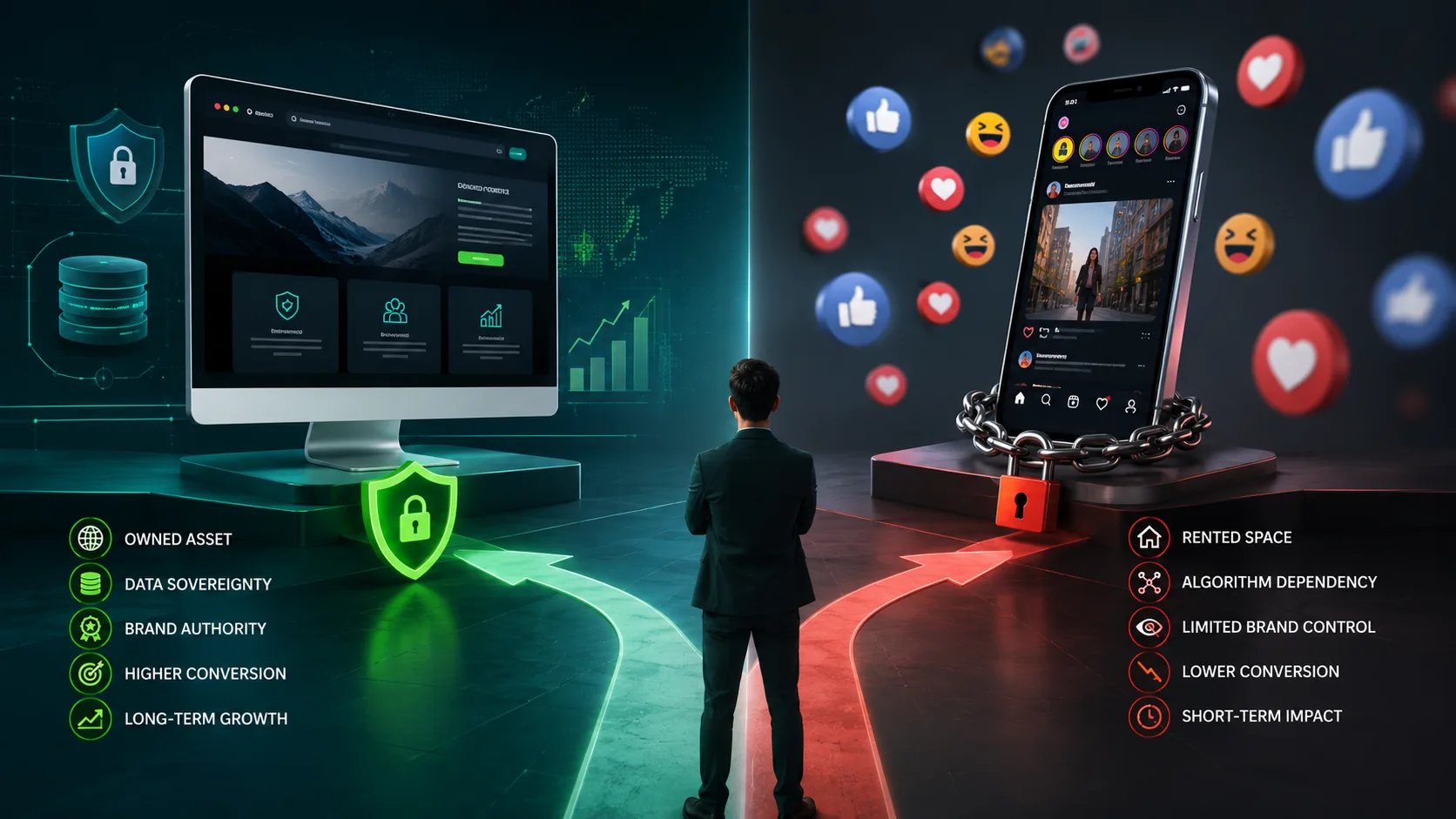
One of the most critical considerations for any business leader is the concept of digital sovereignty. Social media accounts are, essentially, rented spaces on platforms owned by massive corporations.
The Problem of Algorithmic Shifts
Platform owners frequently update their algorithms to prioritize different types of content (e.g., shifting from long-form video to short-form loops). When these shifts occur, a business that has built its entire audience on that platform may see its organic reach drop by 90% overnight.
In 2026, we have seen numerous instances where platform policy changes have silenced brands without warning. Relying on a third-party algorithm means your visibility is always subject to the decisions of stakeholders who do not have your business's best interests in mind.
Data Sovereignty and Privacy
On social media, the platform owns the data. You have limited access to deep analytics regarding individual user behavior, and you cannot easily export your "followers" into a portable format.
A custom website allows for first-party data collection. Through advanced analytics and CRM integrations, you can track the exact path a user takes from their first visit to their final purchase. This data is an intangible asset that increases the valuation of your company.
10 Reasons a Website is Mandatory for Premium Brands
While social media is a powerful tool for visibility, it lacks the technical and psychological depth required to sustain a premium brand image. Here is why a dedicated website is non-negotiable in 2026.
1. Professional Credibility and Trust
A custom domain (e.g., yourcompany.com) provides an immediate signal of legitimacy. In a marketplace saturated with "fly-by-night" social media operations, a website proves that an organization has invested in its infrastructure.
Studies in 2026 continue to show that over 80% of B2B buyers will not engage with a company that lacks a professional website. It serves as a digital business card that carries far more weight than a LinkedIn profile or an Instagram bio.
2. Absolute Design Control
Social media platforms force every brand into the same visual template. Whether you are a luxury software firm or a local cafe, your profile looks essentially the same as your competitors'.
A custom website, particularly one built on robust frameworks like Django, allows for complete aesthetic and functional freedom. You can tailor the user interface (UI) to reflect the premium nature of your services, ensuring that the user experience (UX) is seamless and high-end.
3. SEO and Generative Engine Optimization (GEO)
Search engines like Google, and the newer AI-driven answer engines (Perplexity, ChatGPT Search), prioritize structured, authoritative content. A website allows you to implement technical SEO and AEO (Answer Engine Optimization) strategies that are impossible on social media.
By hosting long-form educational content, technical documentation, and structured data (Schema markup), your website becomes a primary source for AI models. This ensures your brand appears in "AI Overviews" and voice search results.
4. 24/7 Lead Capture and Automation
A website never sleeps. Through the integration of automated workflows, a website can qualify leads, schedule appointments, and process payments while your team is offline.
For example, a relocation services firm can use a custom-coded lead response system on their website to provide instant quotes. This level of automation is not possible within the restricted environments of social media direct messaging.
5. Depth of Content
Social media rewards brevity. However, high-value transactions often require deep technical explanations, case studies, and comprehensive service breakdowns.
A website provides the space for "evergreen" content. A well-written technical blog post can continue to attract high-quality leads via search engines for years, whereas a social media post typically loses its visibility within 24 to 48 hours.
25 Benefits of Building a Business Website in 2026
6. Integration with Enterprise Tools
A professional website serves as the hub for your entire tech stack. You can integrate it with:
- CRM systems (e.g., HubSpot, Salesforce)
- Email marketing automation (e.g., FluentCRM, Mailchimp)
- ERP and inventory management systems
- Custom API endpoints for specialized business logic
Social media platforms offer very limited integration, often keeping your customer data siloed within their ecosystem.
7. Global Reach and Accessibility
A website is globally accessible without the need for a specific app or account. Users do not need to "log in" to view your services on the web. Furthermore, a self-hosted website allows you to optimize for global performance using Content Delivery Networks (CDNs), ensuring fast load times for clients regardless of their location.
8. Enhanced Security and Compliance
For businesses handling sensitive client information, social media is inherently insecure. A custom website allows you to implement rigorous security protocols, including SSL encryption, two-factor authentication, and secure database management.
In 2026, compliance with data protection laws like GDPR and CCPA is mandatory. Managing these legal requirements is significantly easier on a platform you own and control.
9. Custom Functionality and Scalability
As a business grows, its needs become more complex. You might need a client portal, a custom e-commerce engine (like a B2B Python-based system), or an interactive ROI calculator.
Websites are infinitely scalable. You can add modular features as your business evolves. Social media platforms are static; you are limited to the features the platform chooses to provide.
10. Higher Conversion Rates
The user intent on a website is typically much higher than on social media. Users visiting your website are often searching for a specific solution, whereas social media users are often browsing for entertainment.
By removing the distractions found on social platforms (such as ads for competitors or unrelated notifications), a website keeps the focus entirely on your brand, leading to significantly higher conversion rates.
Learn More on this source: Website vs Social Media: Which Your Business Needs First
Comparison Table: Website vs. Social Media
| Feature | Business Website (Owned) | Social Media (Rented) |
| Ownership | 100% Control | Platform Owned |
| Primary Purpose | Conversion & Trust | Discovery & Engagement |
| Design Freedom | Absolute | Highly Restricted |
| SEO/AEO Value | High (Long-term) | Minimal (Short-term) |
| Data Access | Deep Analytics | Limited Metrics |
| Algorithm Risk | Zero | High |
| Credibility | High / Premium | Moderate |
| Cost | Upfront Investment | Free (Organic) / High (Ads) |
The Hybrid Model: Making Both Work Together
The most successful digital strategies in 2026 do not treat this as a binary choice. Instead, they use a "Hub and Spoke" model.
The Hub and Spoke Strategy
In this model, the Website is the Central Hub. It holds the core value, the checkout process, and the authoritative information.
Social Media channels (LinkedIn, Instagram, X, TikTok) are the Spokes. Their job is to distribute "micro-content" that piques interest and drives traffic back to the hub.
How to Execute the Hybrid Strategy:
- Attract: Use social media to share highlights, testimonials, and short videos.
- Redirect: Always include a "Call to Value" that leads the user to a specific landing page on your website.
- Engage: Provide deep-dive content on the website (whitepapers, case studies) to build authority.
- Convert: Use optimized forms and secure payment gateways on your website to close the deal.
- Retain: Use the first-party data collected on your website to fuel personalized email marketing and loyalty programs.
Technical Superiority: Why Architecture Matters
When developing a website, the underlying technology determines its performance, security, and SEO potential. Premium firms often move away from generic page builders in favor of custom frameworks like Python and Django.
Performance and Speed
Custom-coded websites are significantly faster than those bloated with unnecessary plugins and templates. In 2026, page speed is a critical ranking factor for both search engines and user retention. A one-second delay in load time can result in a 7% reduction in conversions.
Security and Scalability
Frameworks like Django are "batteries-included," providing built-in protection against common security threats like SQL injection and cross-site scripting. This level of security is vital for any business that stores client data or processes transactions.
Strategic Insights for 2026
As we look toward the remainder of the year, several trends are clear:
- Video Integration: Websites must now host high-quality, native video content to compete with the engagement levels of social platforms.
- Personalization: Using AI to provide personalized website experiences based on user behavior is no longer a luxury; it is an expectation.
- Mobile-First is Mandatory: With over 70% of web traffic coming from mobile devices, a "responsive" design is the bare minimum. Websites must be built for mobile-first interaction.
Why Your Website Is Not Getting Leads (Fix This First)
Building a Sustainable Digital Identity
The choice between a website and social media is not a matter of one being "better" than the other in a vacuum. It is about understanding that a website provides the foundation, while social media provides the amplification.
A business without a website is a business without a home. It is a transient entity that exists at the mercy of platform billionaires. By investing in a premium, custom-built website, you are securing your brand's future, owning your data, and building a platform that generates value 24 hours a day.
In the premium market, shortcuts like "social-only" strategies often lead to a "cheap" brand perception. High-end clients and B2B partners look for signs of stability and professional investment. A website is the most powerful signal of that stability.
Conclusion: Take Control of Your Digital Future
Navigating the digital landscape of 2026 requires a sophisticated approach that balances immediate reach with long-term asset building. Social media will continue to evolve, but the fundamental need for an owned, controlled, and professional website remains constant.
Do Small Businesses Still Need a Website? The 2026 Verdict
Stop building your digital empire on rented land. Establish your authority, protect your data, and create a conversion engine that reflects the premium quality of your brand.
Contact TenG Spectrum Today
Is your business ready for a digital transformation that goes beyond simple social media posts? At TenG Spectrum, we specialize in high-speed web infrastructure and custom software architecture designed for the premium market.
We don't just build websites; we build digital headquarters that drive growth and ensure data sovereignty. Whether you need a custom Django-based platform, an advanced SEO/AEO strategy, or a complete digital rebranding, our expert team is ready to help you lead your industry.
Contact TenG Spectrum today to schedule a strategic consultation and start building your permanent digital presence.
Frequently Asked Questions
Find quick answers to common questions about this topic