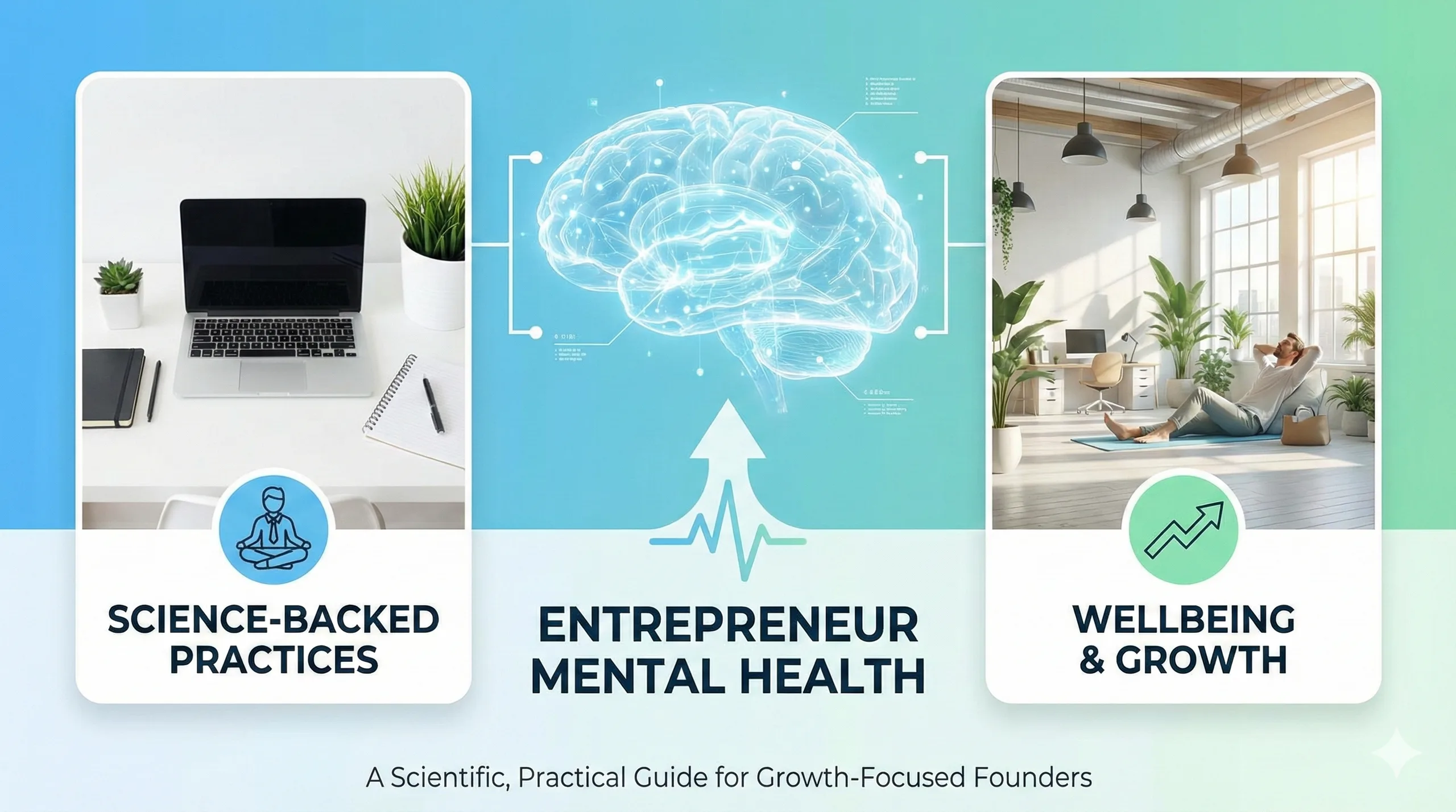
Entrepreneur Mental Health & Wellbeing: A Scientific, Practical Guide for Growth-Focused Founders
Entrepreneurship is often celebrated for its freedom, creativity, and ambition — but behind the scenes lies a different reality that very few talk about openly. Founders carry high cognitive demands, experience long working hours, make continuous decisions, and often work in unpredictable environments. All these factors directly impact the brain and emotional state.
Research in psychology and neuroscience consistently shows one truth: When mental health declines, decision-making, creativity, problem-solving, and leadership ability drop sharply. These are the very skills entrepreneurs rely on daily.
This is why wellbeing isn’t a “personal matter” for business owners — it is a core operational necessity.
At TenG Spectrum, we position ourselves as your digital and growth partner, but our support goes beyond websites and marketing. We care about your overall success — which includes your mental health, emotional stability, and long-term sustainability. When you stay healthy, your business grows faster. When you burn out, everything slows down.
This blog explores the science, the emotional realities, practical solutions, and how TenG Spectrum supports your wellbeing while helping you scale your digital presence.
Why Entrepreneur Mental Health Matters (Scientific Basis)
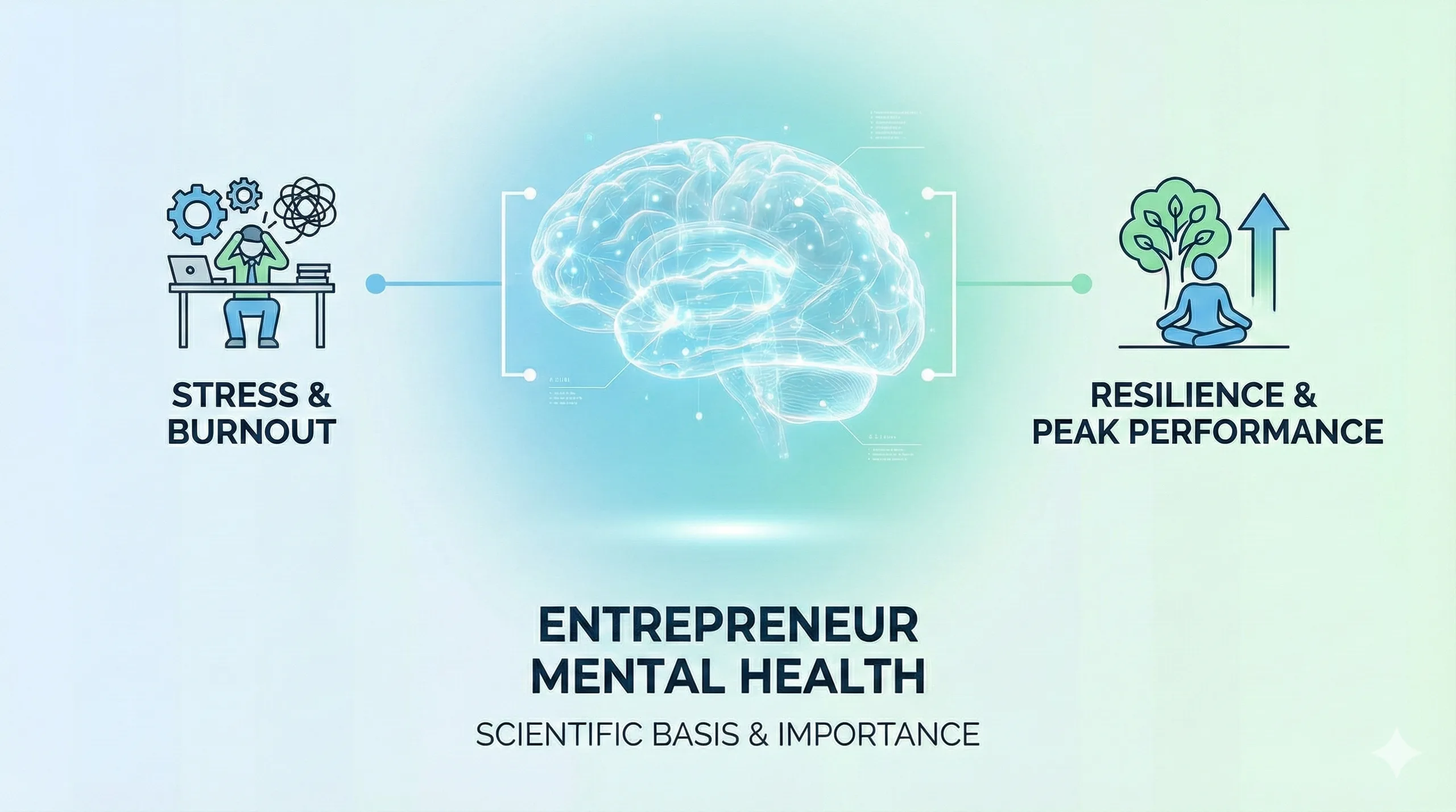
Entrepreneurs experience higher rates of stress, anxiety, and burnout compared to the general population. According to clinical psychology research:
1. Decision Fatigue
The prefrontal cortex — the part of the brain responsible for logic, planning, and decision-making — becomes overloaded when entrepreneurs make dozens of decisions daily. Overload reduces the ability to think clearly.
2. Chronic Stress
High cortisol levels weaken memory, slow creativity, and reduce emotional regulation. Chronic stress also affects sleep quality, which further lowers productivity.
3. Cognitive Overload
Entrepreneurs multitask excessively — finances, sales, marketing, operations, team management. But the brain performs best when focusing on one task at a time.
4. Emotional Isolation
Founders often feel they must appear “strong,” leading to emotional bottling. Psychology studies show this increases anxiety and reduces resilience.
5. Irregular Routines
Skipping meals, inconsistent sleep, no breaks — these weaken executive function and increase irritability.
In simple terms: Your brain is your entrepreneur engine. If you don’t maintain it, everything slows.
The Reality Most Entrepreneurs Don’t Say Out Loud
- You feel responsible for everything
- You constantly think about “what’s next”
- You struggle to switch off
- You fear failure silently
- You try to balance personal life and work, but it feels impossible
- You often ignore your health because “there’s no time”
But ignoring your wellbeing doesn’t help you scale. Mental health protects your creativity, clarity, confidence, and decision power — the core of business success.
Science-Backed Mental Health & Wellbeing Tips for Entrepreneurs
These strategies are based on psychology, neuroscience, and behavioral science.
1. Practice the Micro-Break Method (2–5 minutes every 90 minutes)
Short breaks reset your brain, lower stress hormones, and refresh creativity.
2. Focus on Single-Tasking
Multitasking increases mistakes by 50% and stress by 40%. Do one task fully, then move to the next.
3. Use the 3–3–3 Stress Reset Rule
3 deep breaths 3 minutes of slow, mindful observation 3 things you are grateful for This reduces cortisol and stabilizes mood.
4. Protect Sleep Like a Business Asset
Sleep strengthens memory, decision-making, and emotional control.
5. Create Distinct Work & Personal Boundaries
A simple ritual — like closing your laptop or taking a short walk — signals the brain to switch off.
6. Prioritize Nutrition & Hydration
Entrepreneur energy depends heavily on glucose levels and hydration.
7. Reduce Your Digital Overload
Many entrepreneurs overuse tools instead of simplifying them. Choose tools that reduce effort, not increase complexity.
8. Minimize Overthinking with “Daily Closure”
End each day with:
- 1 task completed
- 1 thing to improve
- 1 plan for tomorrow
Closes mental loops and reduces nighttime anxiety.
9. Seek Professional Help When Needed
Therapists and counselors help regulate stress and improve resilience — a sign of strength, not weakness.
How TenG Spectrum Supports Entrepreneur Wellbeing (Beyond Digital Work)
Yes, we are your digital and growth partner, but our philosophy is simple:
Your health, clarity, and peace of mind are more important than any marketing strategy.
Here’s how we support your wellbeing:
1. We reduce your mental load
We handle website development, SEO, digital marketing, branding, and automation so you can focus on high-value work, not technical pressure.
2. We design digital systems that reduce your stress
Smart automations, funnels, optimized workflows — all aimed at reducing repetitive tasks and mental clutter.
3. We simplify digital communication
Clear, structured communication means you never feel confused or overwhelmed.
4. We create stable digital foundations
Fast websites, secure hosting, easy updates — these remove daily tech stress.
5. We treat your goals and pace with respect
We don’t push you. We support you. Your wellbeing matters just as much as your growth.
This is why clients say TenG Spectrum is not just a digital partner — we are your clarity partner, your stress-reduction partner, and your long-term growth ally.
Prioritizing Health Is Smart Business, Not Soft Business
A healthy mind builds big ideas. A calm mind makes strong decisions. A balanced founder grows a balanced company.
Your wellbeing isn’t something to “fit in later.” It must be your first priority, because everything in your business depends on the quality of your mind.
TenG Spectrum believes in a simple rule: Healthy entrepreneurs build healthier businesses.
If you want a digital partner who values your wellbeing as much as your business growth, TenG Spectrum is here to support your journey — with clarity, care, and strategy. Reach out today and build your business the healthy way.
Scientific Articles Refed
- “Stress, Adaptation, and Disease: Allostasis and Allostatic Load” by B.S. McEwen (1998) — https://pubmed.ncbi.nlm.nih.gov/9629234/
- “Physiology and Neurobiology of Stress and Adaptation” by B.S. McEwen (2007) — https://pubmed.ncbi.nlm.nih.gov/17615391/
- “Cognitive Control in Media Multitaskers” by E. Ophir et al. (2009) — https://www.pnas.org/doi/10.1073/pnas.0903620106
- “Decision Fatigue: A Conceptual Analysis” by G.A. Pignatiello et al. (2018) — https://www.ncbi.nlm.nih.gov/pmc/articles/PMC6119549/
- “A decade of data reveals heavy multitaskers have reduced memory” (Stanford summary) — https://news.stanford.edu/stories/2018/10/decade-data-reveals-heavy-multitaskers-reduced-memory-psychologist-says/
Frequently Asked Questions
Find quick answers to common questions about this topic