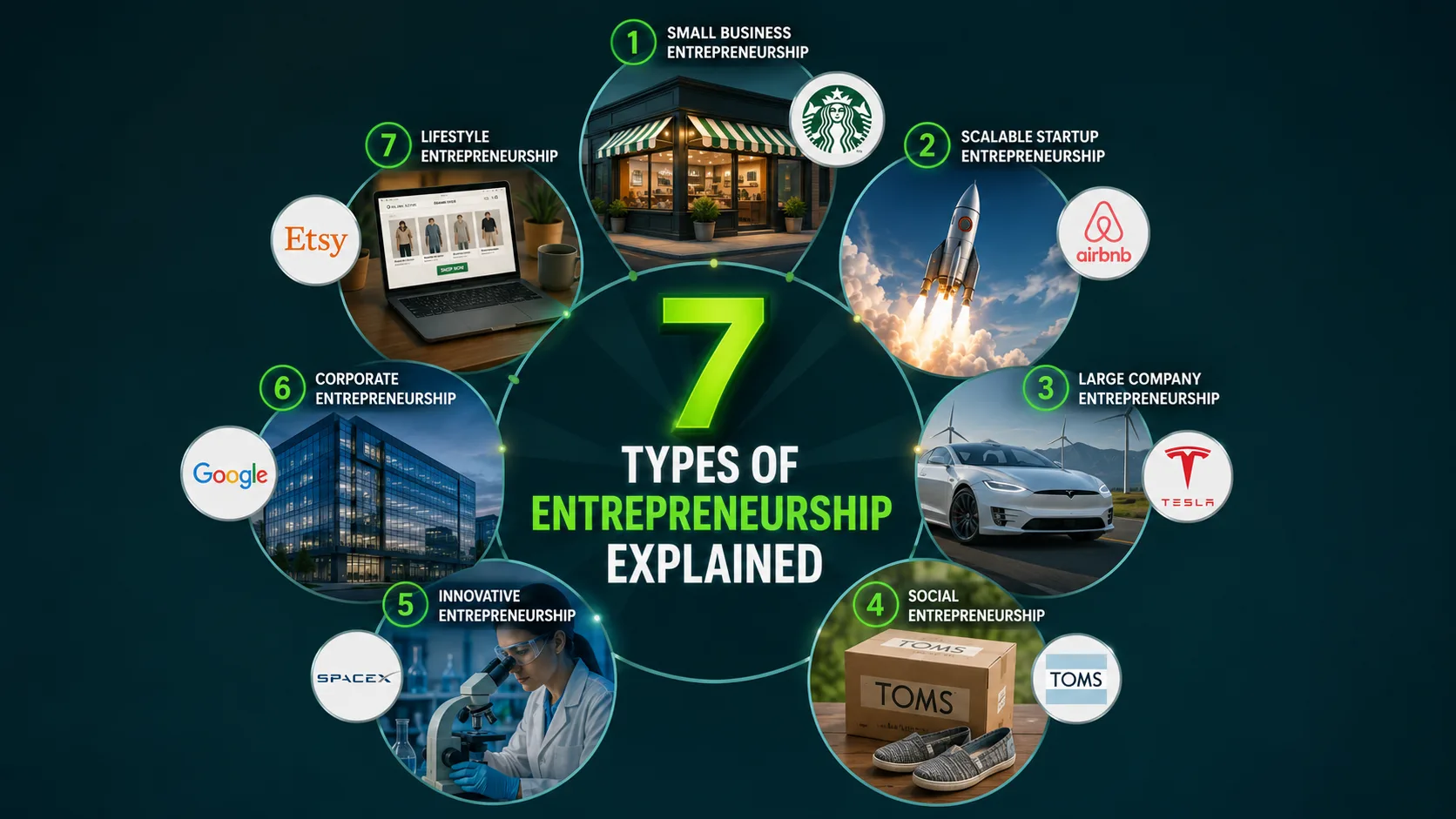
7 Types of Entrepreneurship Explained (With Real Companies Like Airbnb, Tesla and TOMS)
Not every entrepreneur builds the same type of business.
Some entrepreneurs open neighborhood restaurants or retail stores that serve their local communities. Others create technology startups that grow into billion dollar companies. Some entrepreneurs focus on solving social problems, while others innovate inside large corporations without ever starting their own business.
This is why understanding the different types of entrepreneurship is so important.
Many aspiring business owners believe entrepreneurship simply means starting a company. In reality, entrepreneurship exists in many forms, each with its own goals, challenges, funding methods, growth strategies, and risk levels.
Choosing the right type of entrepreneurship can help you build a business that aligns with your skills, financial resources, long term vision, and personal interests.
In this guide, you'll learn the seven major types of entrepreneurship, understand how each one works, explore real world examples from globally recognized companies, and discover which entrepreneurial path may be right for you.
Whether you're a student, aspiring entrepreneur, startup founder, freelancer, or business owner, this guide will give you a practical understanding of modern entrepreneurship.
What Is Entrepreneurship
Entrepreneurship is the process of identifying opportunities, solving problems, taking calculated risks, and creating value by developing products, services, or innovative business models.
Entrepreneurs do more than simply start businesses.
They identify customer needs, improve existing solutions, create employment opportunities, contribute to economic growth, and often transform entire industries.
Successful entrepreneurship combines several important qualities including:
Innovation
Problem solving
Leadership
Creativity
Adaptability
Risk management
Continuous learning
Opportunity recognition
Entrepreneurship can be found in every industry, from healthcare and education to finance, technology, manufacturing, agriculture, and digital services.
15 Habits That Build an Entrepreneurial Mindset for Long Term Success
Why Understanding Different Types of Entrepreneurship Matters
Many new entrepreneurs fail because they choose the wrong business model rather than having a bad business idea.
Understanding the various types of entrepreneurship helps you:
Choose the right business model
Understand funding requirements
Estimate growth potential
Identify suitable markets
Develop realistic business goals
Build an effective long term strategy
Each type of entrepreneurship requires different skills, resources, and expectations.
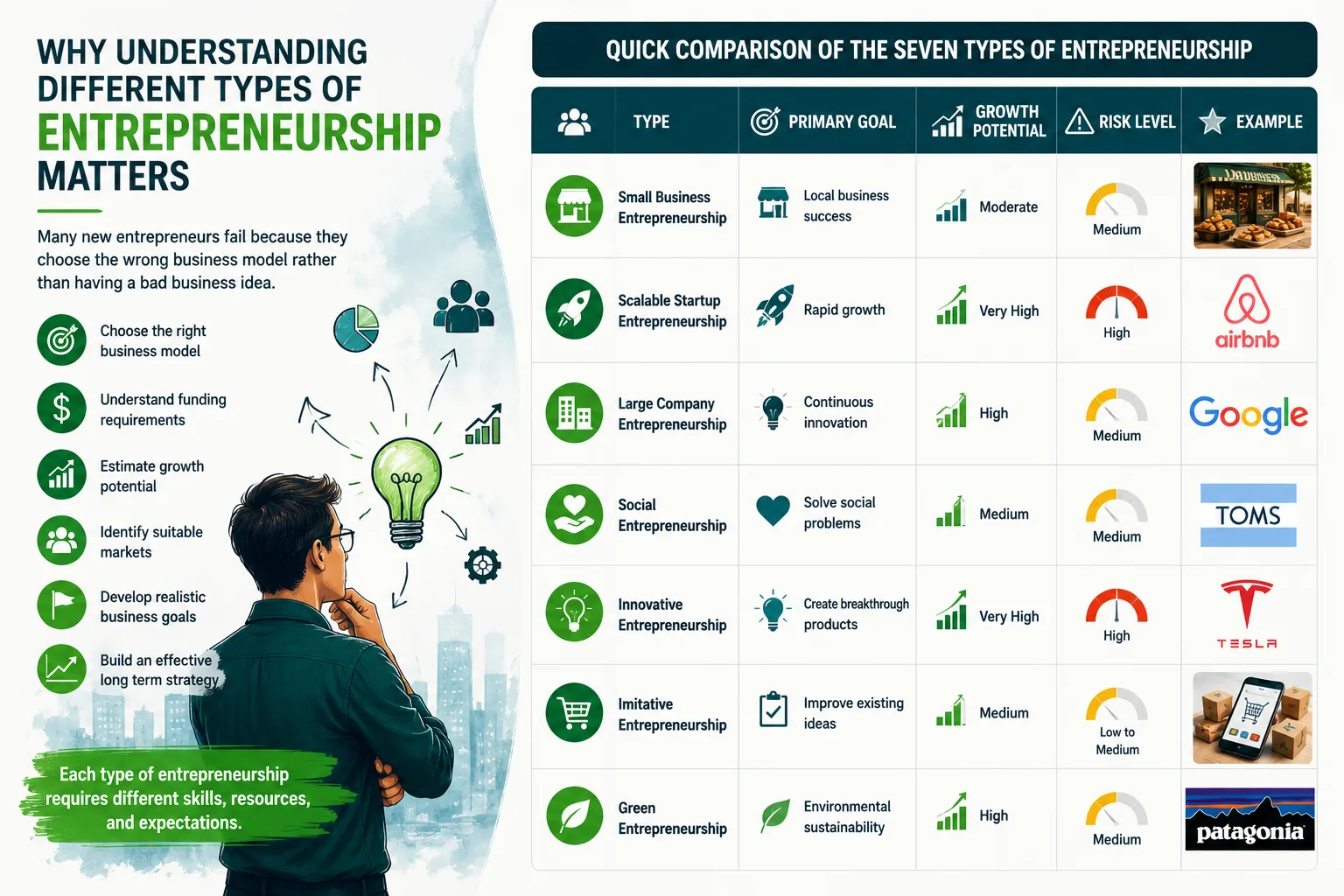
Quick Comparison of the Seven Types of Entrepreneurship
| Type | Primary Goal | Growth Potential | Risk Level | Example |
|---|---|---|---|---|
| Small Business Entrepreneurship | Local business success | Moderate | Medium | Local bakery |
| Scalable Startup Entrepreneurship | Rapid growth | Very High | High | Airbnb |
| Large Company Entrepreneurship | Continuous innovation | High | Medium | |
| Social Entrepreneurship | Solve social problems | Medium | Medium | TOMS |
| Innovative Entrepreneurship | Create breakthrough products | Very High | High | Tesla |
| Imitative Entrepreneurship | Improve existing ideas | Medium | Low to Medium | Regional ecommerce brands |
| Green Entrepreneurship | Environmental sustainability | High | Medium | Patagonia |
Let's explore each type in detail.
1 Small Business Entrepreneurship
Small business entrepreneurship is the most common form of entrepreneurship around the world.
These businesses usually serve local communities rather than global markets.
Examples include:
Restaurants
Retail stores
Coffee shops
Salons
Local marketing agencies
Freelancers
Consulting firms
Local repair services
The primary objective is to generate consistent income while serving customers within a specific area.
Characteristics
Privately owned
Limited employees
Local customer base
Steady growth
Owner managed
Long term sustainability
Advantages
Lower startup investment
Closer customer relationships
Greater flexibility
Lower operational complexity
Steady income potential
Challenges
Limited scalability
Local competition
Dependence on customer loyalty
Managing cash flow
Real World Example
A family owned bakery serving its local community for decades represents successful small business entrepreneurship. Rather than expanding globally, its goal is to build customer trust and provide consistent quality.
2 Scalable Startup Entrepreneurship
Scalable startups are designed to grow rapidly.
Unlike small businesses, startups aim to reach national or global markets through innovation and technology.
Many startups seek funding from angel investors or venture capital firms because they require significant investment before becoming profitable.
Characteristics
Rapid expansion
Technology driven
Innovation focused
Global vision
High investment requirements
Scalable business model
Advantages
Massive growth opportunities
Global market reach
High investment potential
Industry disruption
Challenges
High failure rates
Intense competition
Investor expectations
Rapid hiring
Operational complexity
Finding Hidden Business Opportunities
Real Company Example: Airbnb
Airbnb started with a simple idea.
The founders noticed that hotels were expensive and many homeowners had unused rooms.
Instead of building hotels, they created an online marketplace connecting travelers with property owners.
Today Airbnb operates in thousands of cities worldwide and has transformed the hospitality industry.
Other Examples
Uber
Spotify
Stripe
Dropbox
Zoom
Canva
These companies were built with scalability in mind from the beginning.
3 Large Company Entrepreneurship
Many people assume entrepreneurship only happens in startups.
In reality, large organizations constantly encourage employees to innovate.
This is known as corporate entrepreneurship or intrapreneurship.
Employees develop new products, improve business processes, and identify growth opportunities while working inside established organizations.
Characteristics
Innovation within existing companies
Research and development
New product launches
Internal startup culture
Continuous improvement
Benefits
Lower financial risk
Access to company resources
Experienced leadership
Established customer base
Research funding
Challenges
Organizational bureaucracy
Slower decision making
Internal approvals
Resistance to change
Real Company Example: Google
Google encourages innovation through internal projects.
Products such as Gmail, Google Maps, and Google Photos originated from employees experimenting with new ideas.
Instead of waiting for external startups, Google develops innovation from within the company.
Other Examples
Amazon
Microsoft
Apple
Samsung
3M
These organizations continually innovate to remain competitive.
4 Innovative Entrepreneurship
Innovative entrepreneurship focuses on creating entirely new products, services, or technologies that transform industries.
Unlike businesses that improve existing products, innovative entrepreneurs develop groundbreaking solutions that often change how people live, work, or communicate.
Innovation is one of the strongest drivers of economic growth because it creates new markets, generates employment, and improves people's lives.
Characteristics
Develops original ideas
Invests heavily in research and development
Uses advanced technology
Creates competitive advantages
Focuses on solving major problems
Long term vision
Advantages
Strong competitive advantage
High growth potential
Global market opportunities
Industry leadership
Ability to build valuable intellectual property
Challenges
High research costs
Long development cycles
Market uncertainty
Need for continuous innovation
Greater financial risk
Real Company Example: Tesla
Tesla transformed the automotive industry by proving that electric vehicles could be powerful, attractive, and practical.
Instead of simply manufacturing another car, Tesla combined electric mobility, battery technology, software updates, and autonomous driving capabilities into one ecosystem.
Today Tesla is recognized as one of the world's most innovative companies because it continuously improves its products rather than relying on traditional automotive practices.
Other Examples
Apple
SpaceX
OpenAI
NVIDIA
Dyson
These companies continually introduce innovations that reshape industries.
When Should You Choose Innovative Entrepreneurship?
Innovative entrepreneurship may be suitable if you:
Enjoy solving complex problems
Have technical expertise
Are comfortable taking higher risks
Want to build products that transform industries
Have access to funding for research and development
5 Social Entrepreneurship
Social entrepreneurship focuses on solving social or environmental problems while maintaining financial sustainability.
Unlike traditional businesses that primarily focus on maximizing profits, social entrepreneurs measure success by the positive impact they create for communities.
Profit remains important because it allows the organization to continue operating, but social impact becomes the primary mission.
Characteristics
Mission driven
Community focused
Financially sustainable
Addresses social challenges
Measures impact alongside revenue
Ethical business practices
Advantages
Creates meaningful social impact
Builds strong customer trust
Attracts socially conscious investors
Enhances brand reputation
Supports sustainable development
Challenges
Balancing profit with purpose
Limited funding options
Measuring social impact
Higher operational costs
Scaling social initiatives
Real Company Example: TOMS
TOMS became famous for its One for One business model.
For every pair of shoes purchased, the company donated a pair to children in need.
Although the business model has evolved over time, TOMS demonstrated how entrepreneurship can combine commercial success with social responsibility.
Other Examples
Warby Parker
Grameen Bank
Khan Academy
Teach For America
Charity Water
These organizations prioritize creating positive change while maintaining sustainable operations.
Who Should Consider Social Entrepreneurship?
This type of entrepreneurship is ideal for individuals who want to:
Improve education
Support healthcare
Reduce poverty
Promote environmental sustainability
Empower local communities
Address global social challenges
6 Imitative Entrepreneurship
Many people believe entrepreneurs must invent completely original ideas.
In reality, many successful businesses begin by improving existing products or adapting successful business models to new markets.
This approach is called imitative entrepreneurship.
Imitative entrepreneurs study proven business models and introduce improvements, better customer service, lower prices, or local adaptations.
Innovation still exists, but it focuses on improvement rather than invention.
Characteristics
Builds upon existing ideas
Lower market uncertainty
Customer demand already exists
Focuses on improvements
Adapts successful models
Reduces startup risk
Advantages
Lower business risk
Faster market entry
Existing customer awareness
Lower research costs
Simpler business validation
Challenges
Strong competition
Limited differentiation
Pricing pressure
Need for continuous improvement
Examples
Regional ecommerce marketplaces
Local food delivery platforms
Private label consumer products
Affordable alternatives to premium software
Local ride sharing services
Many successful entrepreneurs begin by improving existing business models instead of creating entirely new industries.
Practical Example
Imagine a small entrepreneur notices that expensive project management software is difficult for local businesses to use.
Instead of inventing project management software from scratch, they create a simpler, more affordable version designed specifically for small businesses.
This is imitative entrepreneurship because it improves an existing solution.
7 Green Entrepreneurship
Green entrepreneurship focuses on creating businesses that protect the environment while remaining financially sustainable.
As consumers become increasingly environmentally conscious, green entrepreneurship continues to grow across many industries.
These businesses seek to reduce pollution, conserve natural resources, minimize waste, and promote sustainable practices.
Characteristics
Environmentally responsible
Sustainable products
Ethical sourcing
Waste reduction
Renewable resources
Long term environmental impact
Advantages
Growing customer demand
Positive brand image
Government incentives
Long term sustainability
Contribution to environmental protection
Challenges
Higher production costs
Complex supply chains
Regulatory compliance
Consumer education
Initial investment requirements
Real Company Example: Patagonia
Patagonia has built its brand around environmental responsibility.
The company encourages customers to repair products instead of replacing them, uses recycled materials, and actively supports environmental conservation projects.
Its commitment to sustainability has created one of the world's strongest outdoor clothing brands.
Other Examples
Beyond Meat
Seventh Generation
Too Good To Go
Ecovative
Allbirds
These companies demonstrate that profitability and sustainability can successfully work together.
Comparing the Seven Types of Entrepreneurship
| Entrepreneurship Type | Main Objective | Investment | Risk | Growth Potential | Best For |
|---|---|---|---|---|---|
| Small Business | Serve local markets | Low to Medium | Medium | Moderate | Local business owners |
| Scalable Startup | Rapid expansion | High | High | Very High | Technology founders |
| Large Company | Continuous innovation | Company funded | Medium | High | Corporate professionals |
| Innovative | Industry transformation | High | High | Very High | Inventors and innovators |
| Social | Solve social problems | Medium | Medium | Moderate | Mission driven founders |
| Imitative | Improve existing ideas | Low to Medium | Low | Medium | First time entrepreneurs |
| Green | Environmental sustainability | Medium | Medium | High | Sustainability focused founders |
Which Type of Entrepreneurship Is Right for You?
Choosing the right entrepreneurial path depends on your goals, resources, skills, and interests.
Ask yourself these questions:
Do I want to serve local customers or global markets?
Am I motivated by profit, social impact, or innovation?
How much financial risk am I willing to take?
Do I enjoy creating new technologies or improving existing products?
Do I have access to funding?
How quickly do I want my business to grow?
Why Customers Buy From Businesses They Feel Familiar With
Quick Guide
If you want stable local income, consider small business entrepreneurship.
If you dream of building the next global technology company, scalable startup entrepreneurship may be the right choice.
If solving social issues motivates you, social entrepreneurship offers a meaningful path.
If sustainability is your passion, green entrepreneurship provides exciting opportunities.
If you enjoy improving existing products, imitative entrepreneurship offers lower risk while still creating value.
Common Mistakes When Choosing an Entrepreneurial Path
Many aspiring entrepreneurs select the wrong business model because they misunderstand their own goals.
Avoid these common mistakes.
Choosing Based on Trends Instead of Passion
Not every successful business model is suitable for every entrepreneur.
Choose an industry you genuinely enjoy learning about.
Underestimating Financial Requirements
Some business types require significant investment before generating revenue.
Research startup costs carefully.
Ignoring Market Demand
Even the most innovative idea requires customers.
Validate your business concept before investing significant resources.
Trying to Scale Too Quickly
Rapid growth without proper planning often creates operational problems.
Build strong foundations before expanding.
Forgetting Customer Needs
Every successful business exists because it solves a real problem.
Always prioritize customer value over personal assumptions.
Key Takeaways
Entrepreneurship is not limited to launching technology startups or building billion dollar companies. It is a broad field that offers multiple paths, each designed to meet different goals, industries, and personal ambitions.
Understanding the seven types of entrepreneurship helps you choose a business model that matches your skills, financial resources, experience, and long term vision.
Here are the most important lessons from this guide:
Small Business Entrepreneurship focuses on serving local communities and building sustainable businesses.
Scalable Startup Entrepreneurship aims for rapid growth and often seeks investment from venture capital firms.
Large Company Entrepreneurship encourages innovation within established organizations through intrapreneurship.
Innovative Entrepreneurship creates new products, technologies, or services that disrupt industries.
Social Entrepreneurship solves social and community challenges while maintaining financial sustainability.
Imitative Entrepreneurship improves existing products, services, or business models to create value.
Green Entrepreneurship combines business success with environmental responsibility and sustainable practices.
Each type contributes to economic development, job creation, innovation, and community growth in different ways.
The best type of entrepreneurship is the one that aligns with your passion, strengths, available resources, and long term objectives.
How to Start Your Entrepreneurial Journey
If you are considering becoming an entrepreneur, follow these practical steps.
Step 1 Understand Your Goals
Ask yourself why you want to start a business.
Do you want financial independence?
Do you want to solve a social problem?
Do you want to build innovative technology?
Do you want to serve your local community?
Having a clear purpose helps you choose the right entrepreneurial path.
Step 2 Identify a Problem Worth Solving
Every successful business begins by solving a real problem.
Observe everyday challenges.
Listen to customer complaints.
Research market gaps.
Study changing consumer behavior.
The larger and more meaningful the problem, the greater the opportunity.
Step 3 Validate Your Idea
Before investing money, confirm that people actually need your solution.
You can validate your idea by:
Conducting surveys
Interviewing potential customers
Creating a landing page
Launching a minimum viable product
Collecting customer feedback
Validation reduces unnecessary risk.
Step 4 Create a Business Plan
Develop a roadmap covering:
Business goals
Target audience
Revenue model
Marketing strategy
Financial projections
Growth plan
A clear business plan improves decision making and attracts investors if needed.
Step 5 Build Your Digital Presence
Today's businesses need a strong online presence regardless of industry.
This typically includes:
Professional website
Search engine optimization
Google Business Profile
Social media presence
Content marketing
Email marketing
Without digital visibility, even excellent businesses struggle to reach potential customers.
Real World Lessons from Successful Entrepreneurs
Although companies like Airbnb, Tesla, Patagonia, Google, and TOMS operate in different industries, they share several important lessons.
They Solved Real Problems
Successful businesses begin with customer needs rather than products.
They Continued Learning
Markets constantly change.
Successful entrepreneurs adapt faster than competitors.
They Were Willing to Take Calculated Risks
Growth requires making informed decisions despite uncertainty.
They Built Strong Brands
Customers remember businesses that consistently provide value.
They Focused on Long Term Growth
Quick profits rarely build lasting companies.
Long term thinking creates sustainable success.
Final Thoughts
Entrepreneurship is not a one size fits all journey. Every successful entrepreneur follows a path that aligns with their goals, skills, resources, and vision for the future.
Some entrepreneurs build trusted local businesses that become the backbone of their communities. Others create innovative technologies that transform industries. Some dedicate their efforts to solving social or environmental challenges, while many drive innovation from within established organizations.
There is no universally "best" type of entrepreneurship. The right choice depends on the value you want to create and the impact you hope to make.
Before launching your business, invest time in understanding your target audience, validating your ideas, studying the market, and choosing the entrepreneurial model that best supports your long term objectives.
The world's most successful companies did not become industry leaders overnight. They started with a clear vision, solved meaningful problems, adapted to changing markets, and consistently focused on delivering value to customers.
Whether your goal is to build a neighborhood business, a global technology startup, or a mission driven organization, understanding these seven types of entrepreneurship provides the foundation for making informed decisions and building a sustainable business.
Ready to Build Your Business Online?
Choosing the right type of entrepreneurship is only the first step. To grow successfully in today's digital world, your business also needs a professional online presence that builds trust, attracts customers, and supports long term growth.
At TenG Spectrum, we help entrepreneurs, startups, and growing businesses transform ideas into successful digital experiences through premium website development, custom web applications, search engine optimization, digital marketing, and business growth strategies.
Whether you are launching your first business, scaling a startup, or modernizing an established company, our experienced team can help you build a strong digital foundation that supports your entrepreneurial journey.
Contact TenG Spectrum today to discover how our website development, SEO, and digital solutions can help turn your business vision into reality.
Frequently Asked Questions
Find quick answers to common questions about this topic