SDN Orchestration Is Simplifying Network Automation at Scale
Modern networks are not established around a handful of stable devices anymore. Rather, cloud workloads, virtual machines, edge devices, IoT endpoints, and distributed systems create shifting connections. This aspect complicates device-based configuration.Software-Defined Networking (SDN) helps to resolve this issue by separating the control plane from the packet-forwarding plane. Orchestration plays the essential role of connecting services, policies, and resources into unified workflows.
What SDN Orchestration Actually Changes
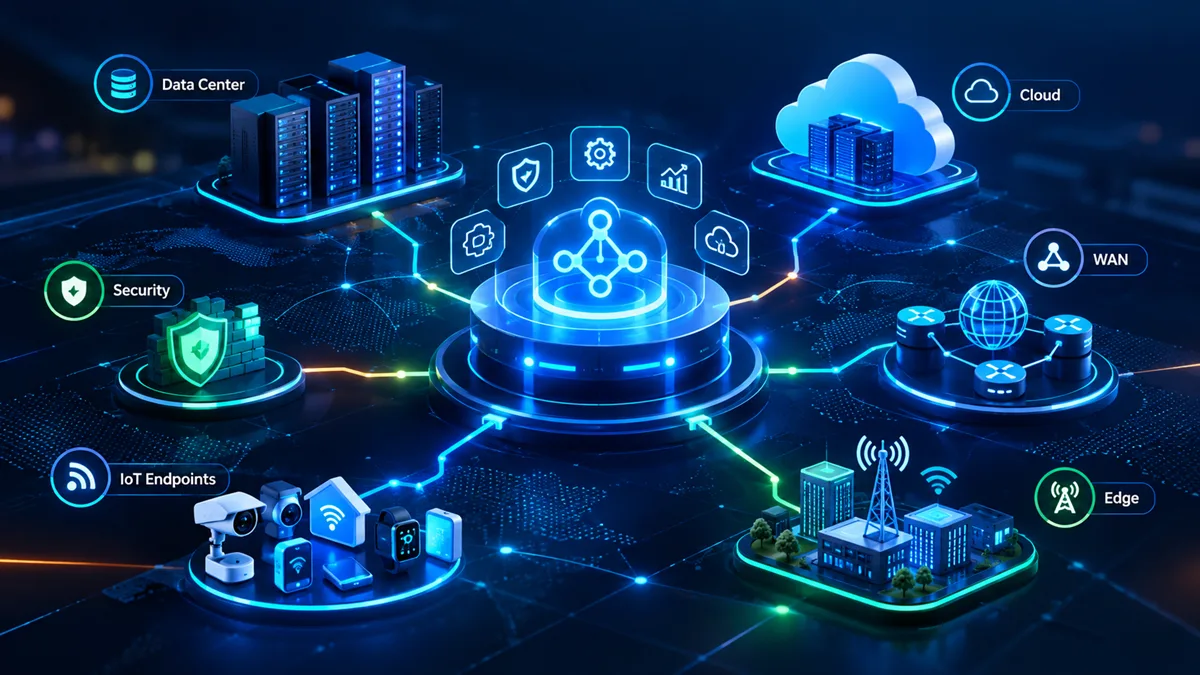
Network orchestration adds a layer of coordination over disparate devices and their respective controllers. With orchestration, a high-level service requirement can be transformed into a synchronized set of configurations across all relevant components of the network.For instance, an enterprise application may rely on a service that spans four distinct operational areas: the data center, WAN, cloud, and perimeter security. The orchestration process allows an engineer to describe this service once and implement required updates by executing calls to underlying APIs and controllers.Research from the National Institute of Standards and Technology (NIST) demonstrates that SDN enhances the consistency and controllability of networks while improving efficiency, safety, reliability, and real-time monitoring. Thus, the real advantage lies not merely in provisioning individual devices, but in minimizing the number of manual decisions required in repetitive operational tasks.
Why Customers Buy From Businesses They Feel Familiar With
The Problems with Manual Network Operations at Scale
Manual configurations are inherently difficult to sustain due to the volume of endpoints, policies, and segments that must be maintained. A network of 500 devices presents a sizable configuration surface area; at 5,000 devices, severe discrepancies, configuration drift, and performance issues inevitably emerge.Several variables make manual operations unfeasible at scale:
- Configuration Complexity: Making a single change to a service can trigger cascading adjustments across numerous switches, routers, security policies, and subnets.
- Change Frequency: Modern continuous deployment pipelines often involve multiple software releases per day, escalating the number of network updates that must be deployed and validated.
- Consistency Risks: Replicating syntax and rule logic manually across multiple environments dramatically increases human error.
- Limited Scalability: Operational routines that work smoothly for 50 devices become unsustainable when infrastructure expands to thousands of endpoints.
NIST research highlights SDN's value across cloud computing, IoT, mobile frameworks, and big-data architectures. Automation does not eliminate operational risk entirely; rather, risk shifts from manual keystrokes toward software logic, policy quality, validation frameworks, role-based permissions, and rollback procedures. Structured testing and governance become vital safeguards as automation expands.
How Orchestration Builds a Repeatable Workflow
A standard orchestration pipeline operates through a series of structured stages:
- Service Definition: The target service or security policy is declared.
- Resource Discovery: The required compute, path, and bandwidth resources are identified.
- Execution: APIs and domain controllers translate the high-level intent into device-specific configurations.
- Validation: Telemetry feeds verify whether the live network has matched the declared state.
Adopting this structured process eliminates the need to execute hundreds of manual configuration commands individually. The operational efficiency becomes unmistakable when applied across 10, 50, or 500 distributed branch locations.This architecture also provides automated rollback capabilities. If a deployed update generates an unexpected routing failure or violates latency thresholds, the orchestrator triggers predefined rollback routines rather than forcing engineers to trace and reconstruct configurations manually under incident conditions.
Automation Across Multi-Vendor Networks
Enterprise networks frequently incorporate hardware and software appliances from several competing vendors. Beyond physical routers, switches, and firewalls, hybrid environments also leverage virtual appliances and cloud-native routing gateways.Orchestration differs fundamentally from standalone automation scripts:
- Standalone scripts (such as custom Python scripts or single-vendor modules) typically address isolated groups of devices using platform-specific CLI commands.
- Orchestration platforms coordinate end-to-end service states across heterogeneous hardware and software layers.
For a service spanning three hardware vendors across four networking tiers, a policy change must translate into distinct API calls or command syntax at each boundary. The orchestration engine maintains end-to-end service intent while abstracting those implementation variations. This ensures network services function uniformly regardless of the underlying hardware vendor.
The Significance of APIs and Programmable Infrastructure
APIs establish standardized communication across controllers, cloud environments, telemetry tools, IPAM databases, and identity systems. An enterprise deployment workflow often integrates five core domains simultaneously:
- Inventory / IPAM Systems: Allocating subnets and verifying physical or virtual endpoints.
- SDN Controllers: Injecting flow tables and interface configurations.
- Cloud Infrastructure Platforms: Orchestrating VPC peering, route tables, and direct connections.
- Security Policy Engines: Enforcing zero-trust network access (ZTNA) and firewall rules.
- Telemetry Platforms: Verifying link health, latency, and packet loss post-deployment.
If a standardized service must roll out across 100 branch offices, an automated workflow enforces the identical policy blueprint while adjusting local parameters dynamically. Because programmatic infrastructure can propagate configurations instantly, strict API authentication, fine-grained access control, automated linting, and audit logging are imperative.
SDN Orchestration and Security Automation
Integrating security with network automation is critical as access policies adapt to dynamic users, microservices, and remote endpoints. Under manual configuration, applying uniform access controls across distributed networks is slow and prone to oversight.SDN orchestration enables dynamic security governance across the infrastructure:
- Automated Microsegmentation: Network segments and access boundaries can adjust on the fly based on workload identities, tags, and compliance profiles.
- Dynamic Traffic Steering: Suspicious or anomalous packets detected by monitoring tools can be redirected automatically through inspection appliances without re-cabling or manual routing changes.
- Standardized Device Profiling: IoT endpoints and edge nodes can be automatically constrained to predefined access paths using policies like Manufacturer Usage Descriptions (MUD).
The security value of orchestration rests heavily on policy verification. While automation applies a correct policy instantly across thousands of nodes, an erroneous rule can propagate just as fast. Pre-deployment policy validation and canary rollouts remain essential safeguards.
Cloud, Edge, and 5G Increase the Need for Orchestration
Distributed computing has expanded the physical boundaries where routing and access decisions take place. Enterprise workloads frequently shift between centralized data centers, regional cloud clusters, and remote edge nodes. Every workload migration introduces real-time policy and connectivity requirements.NIST research on SDN-enhanced edge networks emphasizes the role of software-defined control across access, core, and wide-area networks connecting edge systems with central clouds. Industry projections point to steady, double-digit annual growth in SDN orchestration adoption, driven by the operational overhead of coordinating distributed edge computing and multi-cloud footprints.
Best WhatsApp Plugins for WordPress (2026)
Measuring the Value of Network Automation
Evaluating network automation requires quantifiable operational metrics rather than simply logging the number of automated tasks completed. Meaningful performance indicators include:
- Provisioning Time: Measuring the end-to-end duration required to deliver services to new sites or workloads.
- Configuration Error Rate: Tracking the frequency of misconfigurations and drift incidents.
- Mean Time to Resolution (MTTR): Assessing how quickly automated telemetry detects and isolates failures.
- Change Failure Rate: Measuring the percentage of routine updates that require rollback or hotfixes.
NIST's research framework emphasizes that observable, baseline telemetry is required to prove operational efficiency. Without consistent measurement criteria, teams cannot evaluate whether automation is legitimately saving engineering hours or merely obscuring technical debt.
Traditional Network Management vs. SDN Orchestration
| Operational Area | Traditional Network Management | SDN Orchestration | Measurable Impact |
| Provisioning | Multiple manual CLI configuration steps per device | Declarative, centralized workflows pushing policy across domains | Substantial reduction in delivery lead times |
| Configuration Consistency | Highly dependent on individual engineer practices and device syntax | Standardized blueprints applied uniformly via automated controllers | Workflows scale reliably across 10, 50, or 500+ locations |
| Multi-Vendor Environments | Distinct, isolated procedures required for each vendor's syntax | Abstracted APIs and controllers manage multi-vendor environments | Single workflows span 3 or more vendor platforms |
| Scalability | Operational overhead scales linearly as device counts rise | Repeatable, software-driven pipelines deploy at scale | Predictable management across environments with 1,000+ endpoints |
| Security Deployment | ACLs and firewall rules configured manually per appliance | Security policies coordinated automatically across network segments | Uniform policy deployment and reduced operational expenditures |
| Change Management | Individual modifications require manual human verification | Workflows embed automated validation and rollback triggers | Single pipelines coordinate changes across hundreds of sites |
| Hybrid Connectivity | Cloud, WAN, and on-premise networks managed in silos | Orchestration synchronizes resources across data center, WAN, and cloud | Unifies management across 4 or more infrastructure layers |
| Remediation | Detection and manual troubleshooting occur as disjointed steps | Real-time telemetry triggers automated, predefined remediation | Supports continuous, threshold-based automated responses |
Remaining Implementation Challenges
While SDN orchestration solves configuration fragmentation, it introduces its own engineering considerations:
- Legacy Hardware Compatibility: Older network appliances lacking native REST, NETCONF, or gRPC interfaces require translation wrappers, which can introduce latency and points of failure.
- Misguided Automation: Automating a poorly designed network design merely executes bad processes faster. Complex workflows must be simplified before they are automated.
- Security & Access Control: Orchestration engines hold elevated privileges across multiple segments. Strong identity governance, MFA, granular RBAC, and immutable audit trails are necessary.
- Architectural Blast Radius: In a centrally coordinated architecture, an error in an orchestration template can propagate across an entire enterprise footprint within seconds.
The Future of SDN Orchestration
The next phase of network orchestration centers on closed-loop automation—combining intent-based policy engines, real-time streaming telemetry, and automated verification.Rather than executing static scripts, closed-loop orchestration creates an adaptive operational cycle:
- Define the desired network state and performance thresholds (e.g., maximum allowable latency or packet loss).
- Deploy the configuration across physical and virtual layers.
- Continually monitor telemetry against the established service-level objectives (SLOs).
- Automatically execute traffic engineering or rerouting if parameters breach defined thresholds.
Recent research into network verification and structured graph repositories demonstrates how formal validation tools can model routing behavior and BGP policies before production rollout. As enterprise infrastructure expands in speed and scale, orchestration provides the repeatable, software-driven foundation required to operate complex networks safely.
Conclusion
The shift toward coordinated workflows in SDN orchestration provides a viable framework for managing modern network complexity. By separating intent from device-level syntax, engineering teams can coordinate policies, provisioning, security enforcement, and observability across hybrid infrastructure—spanning on-premises hardware, multi-cloud platforms, and distributed edge nodes.However, reliable automation depends on rigorous validation, well-defined network models, and disciplined testing. When built on strong architectural governance, SDN orchestration eliminates repetitive manual intervention while delivering resilient, scalable network infrastructure.
References
- Dataintelo — SDN Orchestration Market Research Report 2034 Market size, CAGR, provisioning-time reduction, operational-cost reduction, deployment data, and 5G/cloud-related market insights. DataIntelo SDN Orchestration Market Research Report 2034
- NIST — Software Defined Virtual Networks Information on SDN programmability, network virtualization, measurement, security, robustness, and performance testing. NIST Software Defined Virtual Networks
- NIST — Software Defined Networking (SDN) Enhanced Edge Computing: A Network Centric Survey Research covering SDN across access, core, and WAN environments connecting edge computing with cloud infrastructure and programmable interfaces for IoT devices. NIST SDN Enhanced Edge Computing Survey
- NIST — Towards Software Defined Measurement with Open vSwitches: Designs, Implementation, and Evaluation Research on programmable network measurement using Open vSwitch and the relationship between forwarding and measurement functions. NIST Open vSwitch Software Defined Measurement Research
- NIST — Guide to a Secure Enterprise Network Landscape, SP 800-215 Guidance covering cloud services, distributed IT environments, microservices, microsegmentation, SD-WAN, network security, and security automation. NIST Guide to a Secure Enterprise Network Landscape
- NIST — A Smart Network Repository Based on Graph Database 2024 research on network management, network verification, knowledge graphs, BGP route policies, and forwarding behavior analysis. NIST Smart Network Repository Based on Graph Database