
There's a quiet revolution happening in the startup world and it doesn't involve venture capital, co-founders, or engineering teams. In 2026, over one-third of all new startups are founded by a single person. Solopreneurs now represent 41.8 million individuals in the United States alone, contributing more than $1.3 trillion to the economy. The tools available today have made something that once seemed impossible, building a real, scalable SaaS product alone, not just possible, but increasingly common.
So how exactly is one person doing what used to take an entire company? The answer lies in a powerful convergence: AI-powered development, no-code platforms, agentic automation, and a new mindset around what it means to "build software."
The Old Way vs. The New Reality
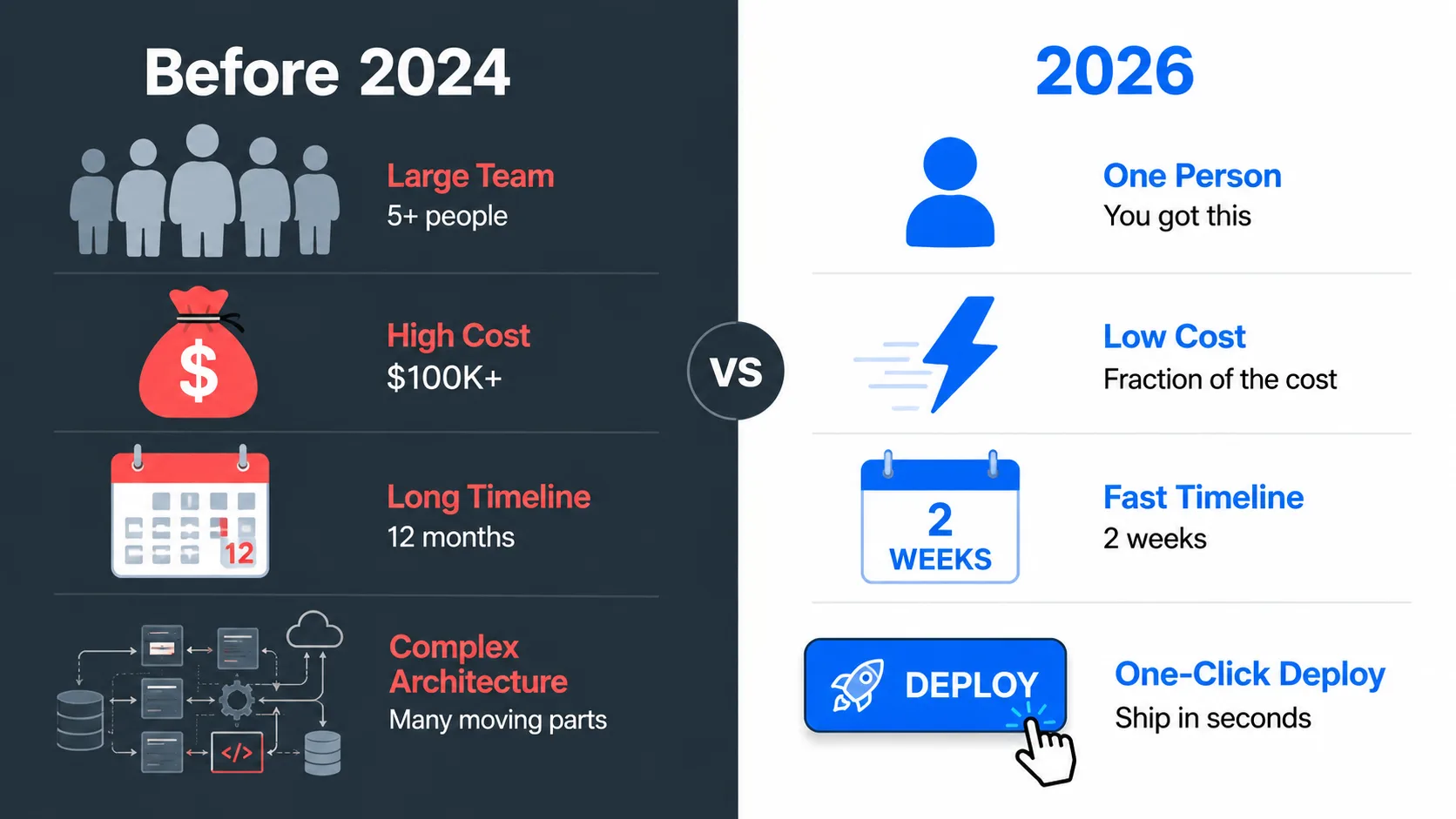
Not long ago, building a SaaS product followed a predictable (and expensive) path: raise money, hire developers, spend six to twelve months in development, then launch and hope for the best.
Even a modest MVP could cost $50,000 to $150,000 before a single paying customer existed.
That model is increasingly obsolete.
Today, solo founders are launching functional SaaS products in weeks, sometimes days using a combination of tools that handle everything from frontend design to backend logic to deployment pipelines. The infrastructure that used to require a DevOps engineer, a frontend developer, a backend developer, and a product manager can now be managed by one person with the right stack.
This isn't about cutting corners. It's about leverage.
What Is Vibe Coding and Why It Changes Everything
In early 2025, Andrej Karpathy, former AI Director at Tesla and co-founder of OpenAI coined the term "vibe coding" to describe a new approach to software development: you describe what you want in plain English, and AI writes the code.
A year later, it's a $4.7 billion market projected to reach $12.3 billion by 2027.
The numbers tell the real story:
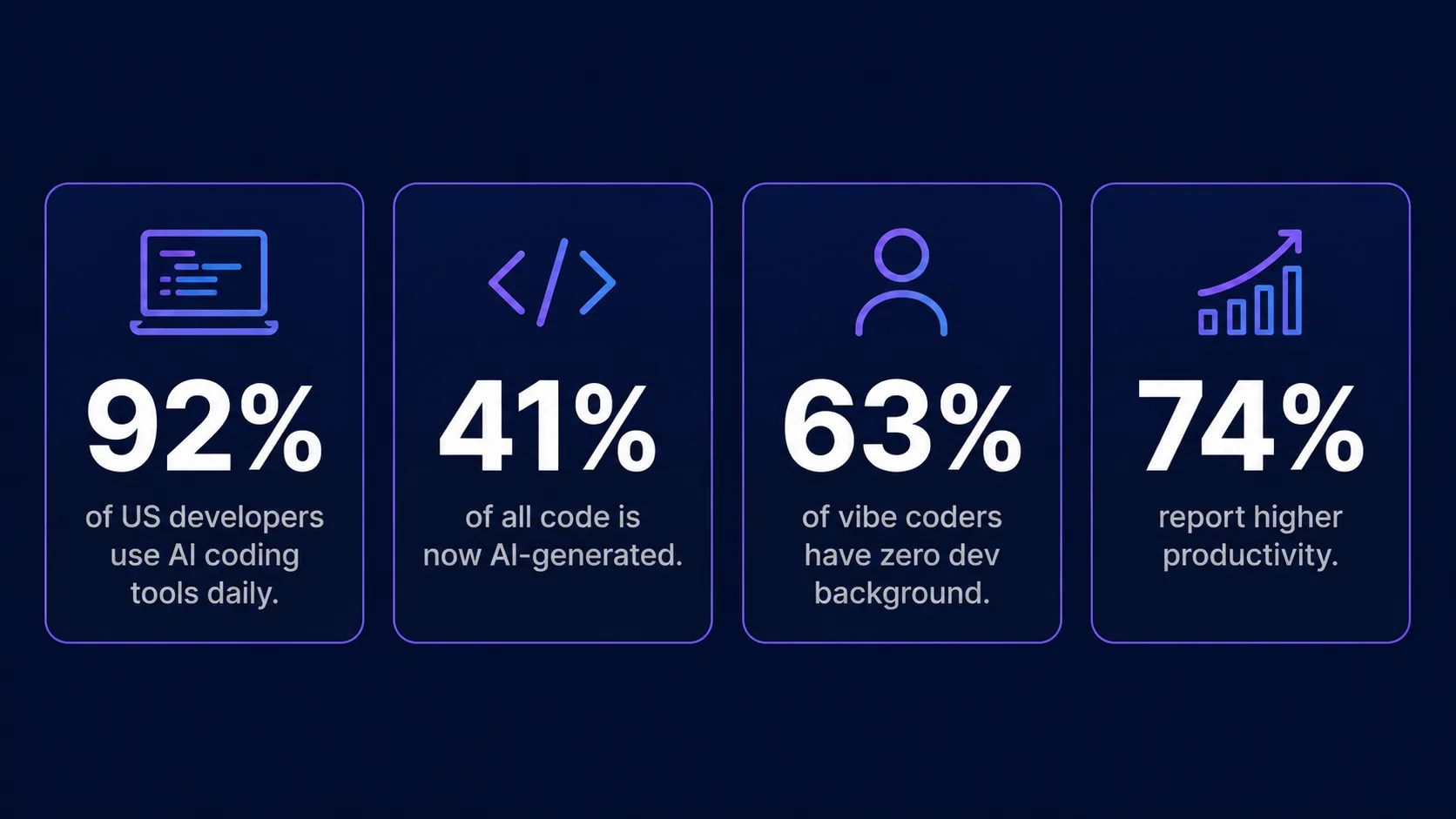
? 92% of US developers now use AI coding tools daily
? 41% of all global code is AI-generated, that's 256 billion lines written in 2024 alone (Source: EliteBrains)
? 63% of vibe coding users are non-developers meaning people with no traditional coding background are shipping real products
? 74% of developers report increased productivity when using AI-assisted coding approaches
For solo founders, vibe coding isn't just a productivity boost. It's a fundamental shift in the barrier to entry. You no longer need to know how to write a database schema or configure a REST API from scratch. You need to know what you want to build and be able to describe it clearly.
The Modern Solo Founder's Stack
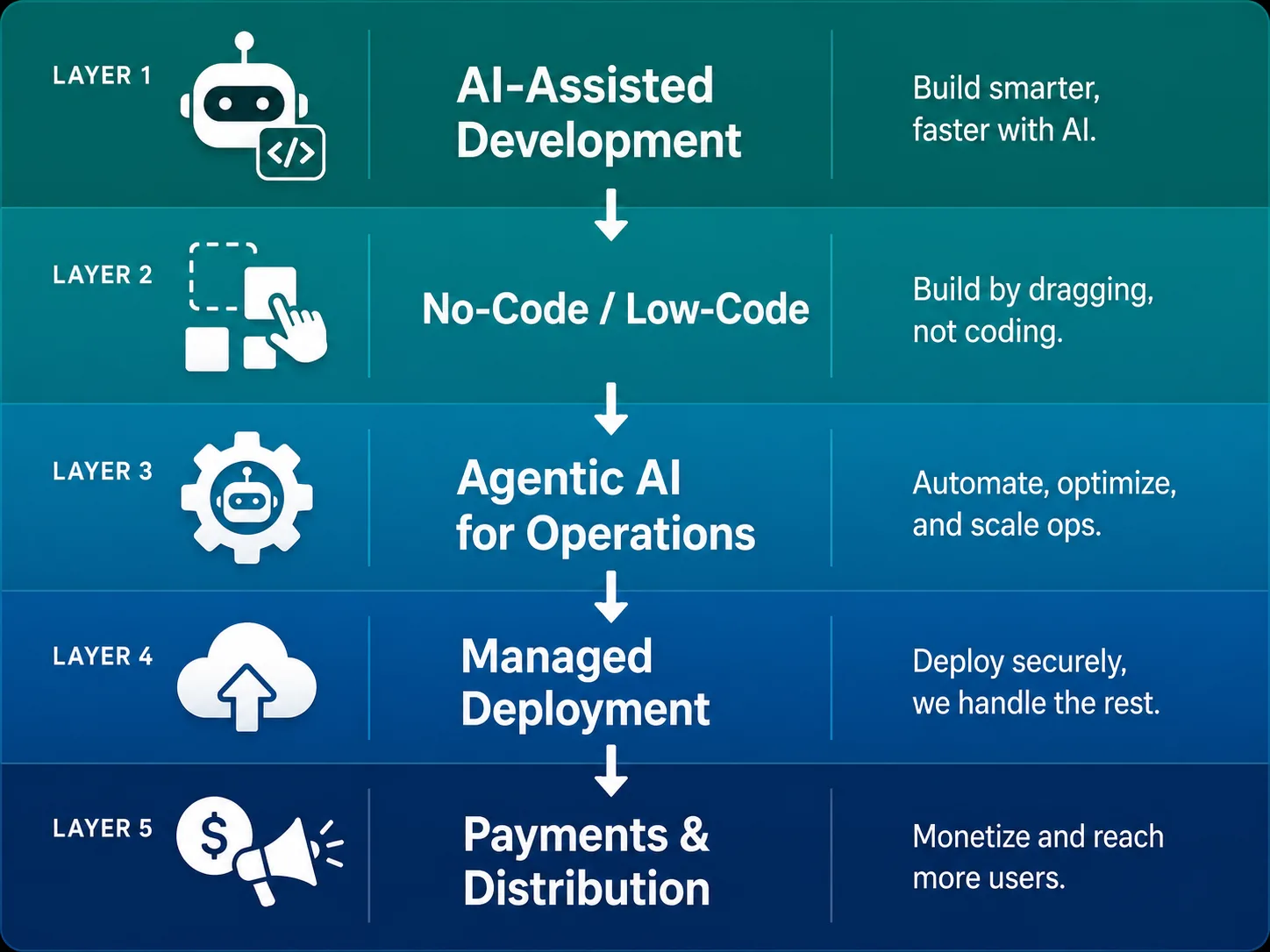
What does the actual toolkit look like? Here's how today's solo founders are putting it together:
1. AI-Assisted Development
Tools like Cursor, GitHub Copilot, and Bolt.new handle the heavy lifting of code generation. A founder can describe a feature in natural language and get working code in seconds. More importantly, these tools help debug, refactor, and explain code meaning solo founders can maintain and evolve their codebase without getting stuck.
2. No-Code / Low-Code Layers
For founders who want to move even faster, platforms like Bubble, Webflow, and Glide let you build functional web apps without writing a single line of code. These aren't toy projects either, some no-code SaaS products are generating $10,000 to $50,000 MRR.
3. Agentic AI for Operations
This is where things get genuinely interesting. Agentic AI platforms let solo founders automate entire workflows, customer support, onboarding sequences, lead qualification, content generation that would otherwise require dedicated team members. Platforms like Kuberns which provides Agentic-AI managed infrastructure, allow developers to deploy and scale apps without managing servers, while AI Agent handle the operational layer on top. The result is a one-person operation that punches well above its weight.
4. Managed Deployment Infrastructure
Deployment used to be a full-time job. Today, platforms that handle CI/CD, autoscaling, environment management, and monitoring automatically mean solo founders can focus entirely on product and customers, not infrastructure. According to a 2026 report, developer teams using AI-managed PaaS solutions cut infrastructure setup time by over 70% compared to raw cloud IaaS configurations.
5. Payment and Distribution
Stripe handles billing. Lemon Squeezy handles global taxes. Product Hunt, Twitter/X, and niche communities handle distribution. The entire commercial layer, accepting payments from anywhere in the world, handling subscriptions, managing refunds takes less than an afternoon to set up.
Real Examples: Solo Founders Who Shipped It
The indie hacker community is full of proof points.
? Pieter Levels, arguably the most famous solo founder, built Nomad List and Remote OK without a dev team, generating millions in annual revenue. His philosophy: ship fast, charge early, iterate based on real users.
? Tony Dinh built Black Magic, a Twitter analytics tool, as a solo project. It crossed $50,000 MRR within a year of launch while he was working alone.
? Marc Lou has launched over 12 micro-SaaS products as a solo founder, with several crossing $5,000+ MRR each. His total solo portfolio generates well over $1 million ARR.
These aren't outliers anymore. They're early examples of a pattern that's becoming the norm.
According to data compiled by Vibrant Snap, over 30 micro-SaaS products have been documented generating between $1,000 and $100,000 MRR, all built and operated by single individuals.
25 Benefits of Building a Business Website in 2026
The Mindset Shift That Makes It Work
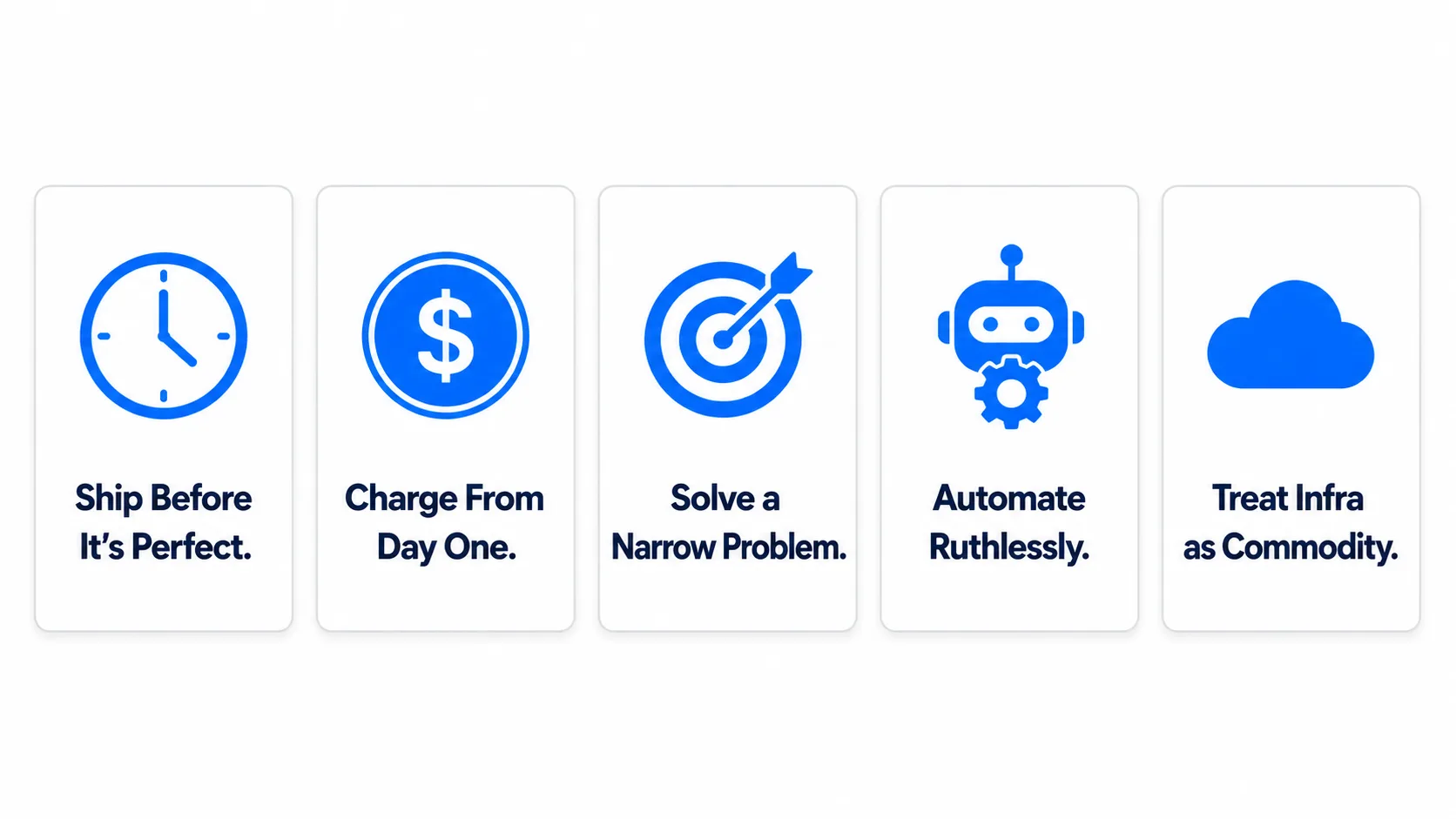
The tools are necessary but not sufficient. What actually separates solo founders who ship from those who don't is a specific way of thinking about building.
Ship before it's perfect: The instinct to polish before launching is the single biggest killer of solo SaaS projects. Get something in front of real users in weeks, not months.
Charge from day one: Free users don't validate a business. A paying customer, even if it's just one, tells you something a thousand free signups can't.
Solve a real, narrow problem: Micro-SaaS works because it's specific. The goal isn't to build the next Salesforce, it's to build the thing that does one job extremely well for a specific audience.
Automate ruthlessly: Every hour spent on repetitive manual work is an hour not spent on product or customers. AI agents, Zapier workflows, and smart tooling can run large parts of your business while you sleep.
Treat infrastructure as a commodity: The days of spending weeks on server configuration are over. Use platforms that abstract away the complexity. The goal is to reduce the time between "idea" and "deploy and live" to as short as possible. Tools offer Agentic AI deployment that handles scaling, monitoring, and DevOps automatically giving solo founders the backend muscle of an entire engineering team without the headcount.
The Challenges Solo Founders Still Face
It's important to be honest: building alone isn't without real challenges.
Wearing every hat is exhausting: You're the developer, marketer, customer support rep, accountant, and product manager simultaneously. Burnout is a real risk, and the line between hustle and overwork is easy to cross.
Support bottlenecks: When you're the only person, every customer issue lands on your plate. Without good automation and clear documentation, this can become a time sink fast.
Limited perspective: Teams catch blind spots. Solo founders have to actively seek feedback, engage communities, and build in public to compensate for the lack of internal review.
Technical debt accumulates: Moving fast with AI-generated code is great for shipping but code quality and architecture decisions can become expensive to revisit later. Building in a way that's maintainable from the start saves significant pain down the road.
None of these are dealbreakers. But they're worth planning for, not ignoring.
Why Professional Services Become Essential for Long-Term Growth?
The solo founder model is a powerful way to validate an idea, reach early revenue, and prove a market. But there is a ceiling and most founders hit it earlier than they expect.
When a micro-SaaS starts attracting enterprise customers, the rules of the game change. An enterprise procurement team will ask for a SOC 2 report before signing. A legal team will require a data processing agreement that covers GDPR, CCPA, and industry-specific regulations. A security review will flag vulnerabilities in AI-generated code that passed no formal review process. These are not optional requirements for enterprise customers, they are table stakes.
This is where the gap between a prototype and a high-end, scalable business asset becomes consequential.
Enterprise-grade security: AI-generated code is fast, but it is not audited. A solo founder typically has no formal security review process, no penetration testing cadence, and no incident response plan. Professional software development firms bring structured security practices, code audits, vulnerability assessments, dependency scanning, and security architecture review that transform a functional product into one that can withstand enterprise scrutiny.
Risk management at scale: When a solo product is used by thousands of businesses, the risk surface changes entirely. Data loss, compliance failures, and service outages carry legal and reputational consequences that a single founder cannot absorb. Professional teams implement redundancy, disaster recovery, and audit trails that protect both the business and its customers.
Website vs Social Media: Strategic Choice for Business Growth in 2026
Transitioning from prototype to scalable architecture: The fastest path to a working MVP is often not the best long-term architecture. Features built on AI-generated scaffolding, no-code layers, and quick integrations accumulate technical debt that eventually slows development to a crawl or makes the system fragile under load. A professional development firm can re-architect the core of the product, rebuild the data model, refactor the API layer, and implement proper infrastructure without disrupting the existing customer base.
Regulatory and compliance requirements: Depending on the industry, operating at scale triggers compliance obligations that require documented processes and professional oversight. Healthcare applications need HIPAA compliance. Financial tools need SOC 2 or PCI DSS. A SaaS serving enterprise HR teams may need to comply with data residency laws across multiple jurisdictions. These requirements are not achievable through vibe coding alone. They require expert-led development with compliance as a first-class concern from the architecture level.
The solo founder model and professional services are not in opposition. The most successful founders use the solo phase to prove the market and reach initial revenue, then bring in expert development partners to build the infrastructure that allows the business to grow without breaking.
Is This the Future of Software?
A reasonable question: is the solo founder model a temporary trend, or a permanent shift in how software gets built?
The evidence suggests the latter.
As AI coding tools become more capable, the gap between "what one person can build" and "what a team can build" continues to narrow. The cost of infrastructure continues to fall. Distribution through social platforms, communities, and product directories becomes more accessible, not less.
The economic logic is compelling too. A solo SaaS doing $10,000 MRR is a life-changing business for one person. That same revenue split across a team of five is barely a salary. Solo economics work in a way that team economics often doesn't, especially at the micro-SaaS scale.
What's changing is the definition of leverage. Previously, leverage meant capital and headcount. In 2026, leverage means AI tools, automated infrastructure, and the ability to move faster than organizations that are still waiting for sprint planning meetings.
According to Forbes, solo founders are now vibe coding digital products that generate revenue from day one, with no technical co-founder required.
Getting Started: What to Do This Week
If you're a developer or someone with a problem worth solving, here's the most direct path forward:
1. Identify a specific, painful problem you or others experience regularly
2. Validate it cheaply: a landing page, a tweet, a DM to 10 potential users
3. Build the smallest possible version using AI coding tools and managed deployment
4. Charge for it before it's feature-complete, even a waitlist with a price reveals demand
5. Use AI agents and automations to handle everything that doesn't require your direct attention
The barrier has genuinely never been lower. The question isn't whether one person can build a SaaS product, it's whether you're willing to start.
Frequently Asked Questions
Find quick answers to common questions about this topic