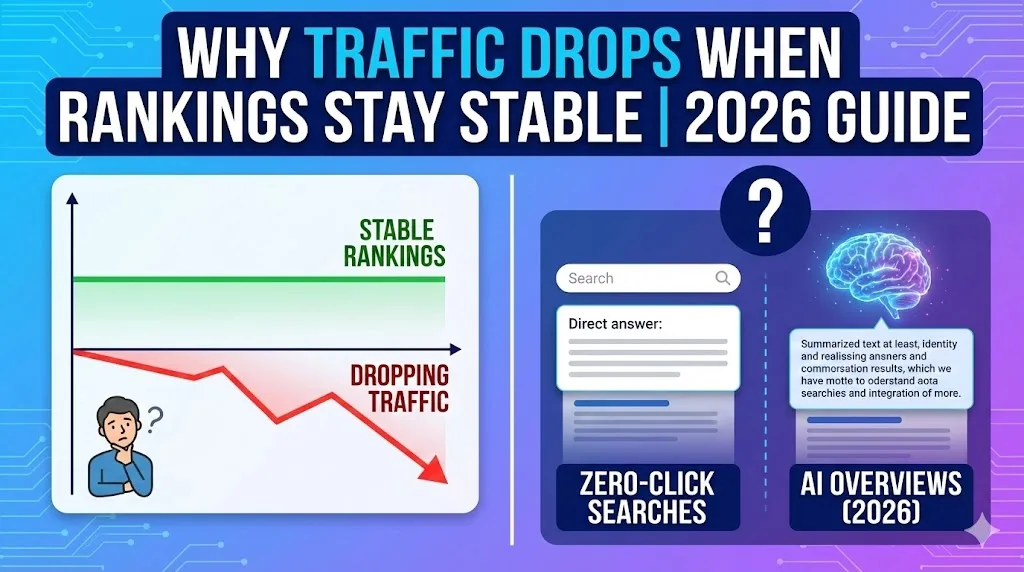
Why Traffic Declines When Rankings Remain Stable
If your keyword rankings are holding steady but your organic traffic is plummeting, you are likely experiencing the Zero-Click phenomenon driven by AI Overviews (AIO) and fragmented search intent. In 2026, maintaining a "Number 1" position no longer guarantees a click if an AI agent or a featured snippet provides a comprehensive answer directly on the search engine results page (SERP).
How to Grow My Business Online: The 2026 Strategic Guide for MSMEs & Professionals
The "Why": Analyzing the 2026 Search Ecosystem
The primary culprit is Snippet Saturation. Search engines have transitioned from "link portals" to "answer engines." With the widespread integration of generative AI into the SERP, informational queries are increasingly resolved without the user ever leaving the results page. Even if your Python/Django-powered site remains the top cited source, the AI summary may extract the "snackable" data points, satisfying the user's intent immediately.
Furthermore, Search Fragmenting has redirected traffic to alternative discovery platforms. Users are increasingly bypassing traditional search for conversational AI assistants, niche community hubs like Reddit, and visual discovery tools. This shift means that while your "rank" in a legacy index is high, the total volume of users utilizing that specific index for that query has shrunk. Finally, the rise of SERP Crowding—where AI modes, shopping modules, and local packs push organic links "below the fold"—means your stable ranking is physically less visible than it was a year ago.
How to Diagnose and Pivot Your Strategy
To recover value in a zero-click environment, you must shift your focus from raw traffic to Generative Engine Optimization (GEO) and brand citations. Use the following checklist to audit your performance:
- Analyze CTR by Feature: Use Google Search Console to determine if your impressions are stable but Click-Through Rate (CTR) has dropped on pages with active AI Overviews.
- Audit Search Intent: Identify if your keywords are "Informational" (high risk for zero-click) or "Transactional" (higher click intent).
- Implement Semantic Schema: Use advanced JSON-LD structured data to ensure AI agents correctly attribute your content, increasing the likelihood of being a "cited source" within AI summaries.
- Monitor Brand Mentions: Track how often your brand is mentioned across LLMs (Large Language Models), as these "off-site" signals now influence authority more than traditional backlinks.
- Optimize for Conversion, Not Clicks: Focus on "high-intent" long-tail queries where users need a specific tool, service, or deep expertise that an AI summary cannot provide.
Contact TenG Spectrum today for premium digital solutions that ensure your brand remains visible and authoritative in the age of AI search.
Frequently Asked Questions
Find quick answers to common questions about this topic