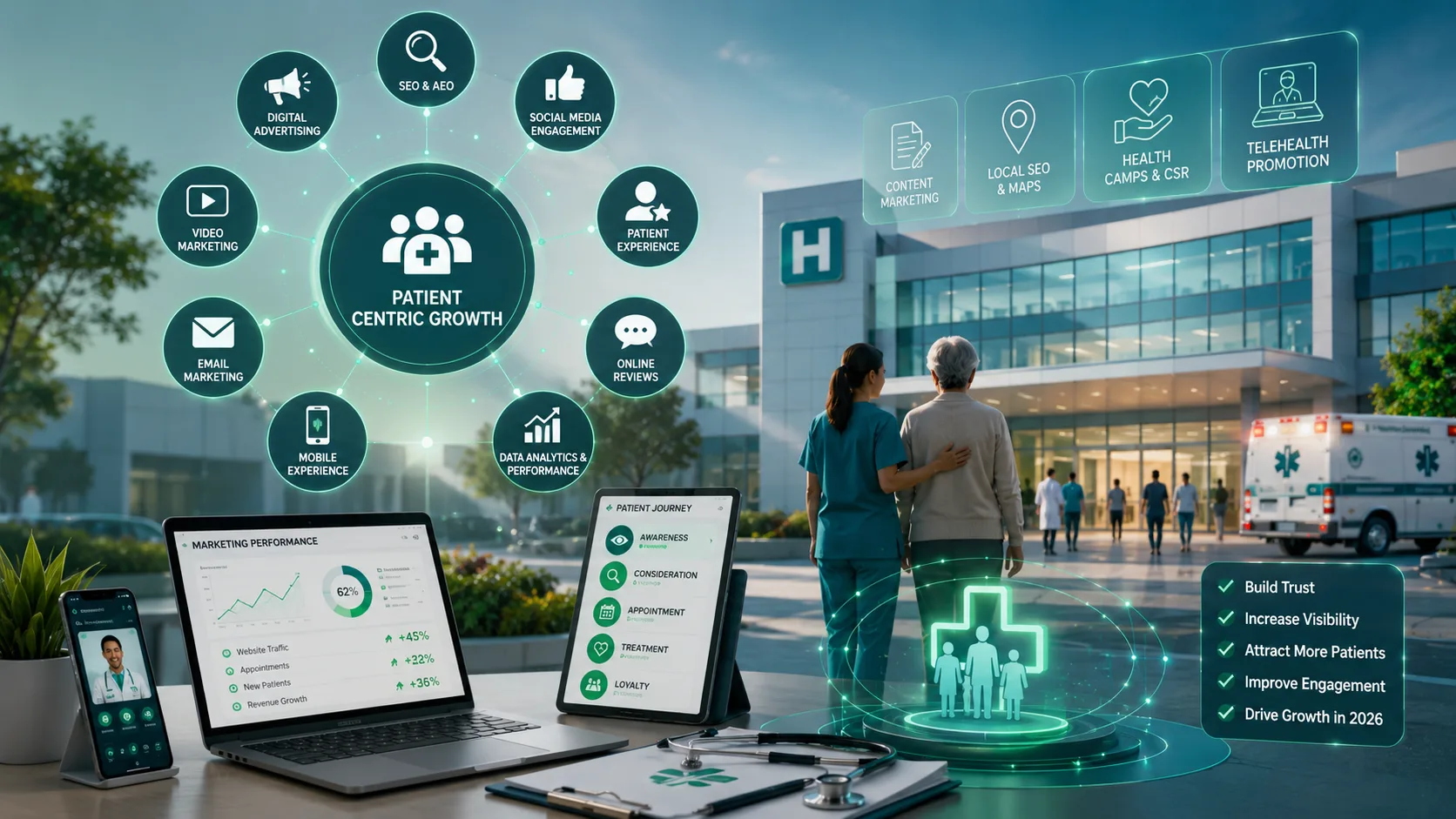

Healthcare in 2025 is fully moving to digital-first, especially in India where government policy, patient expectations, and technology are pushing hospitals and clinics to modernize quickly. For a new clinic or hospital, digital transformation is no longer a “nice-to-have” project; it directly affects patient acquisition, operational cost, and long-term reputation.?
This guide breaks down exactly what digital transformation means for clinics and new hospitals, which tools to start with, and how to implement them step by step without getting overwhelmed.
Why clinics need a digital strategy in 2025
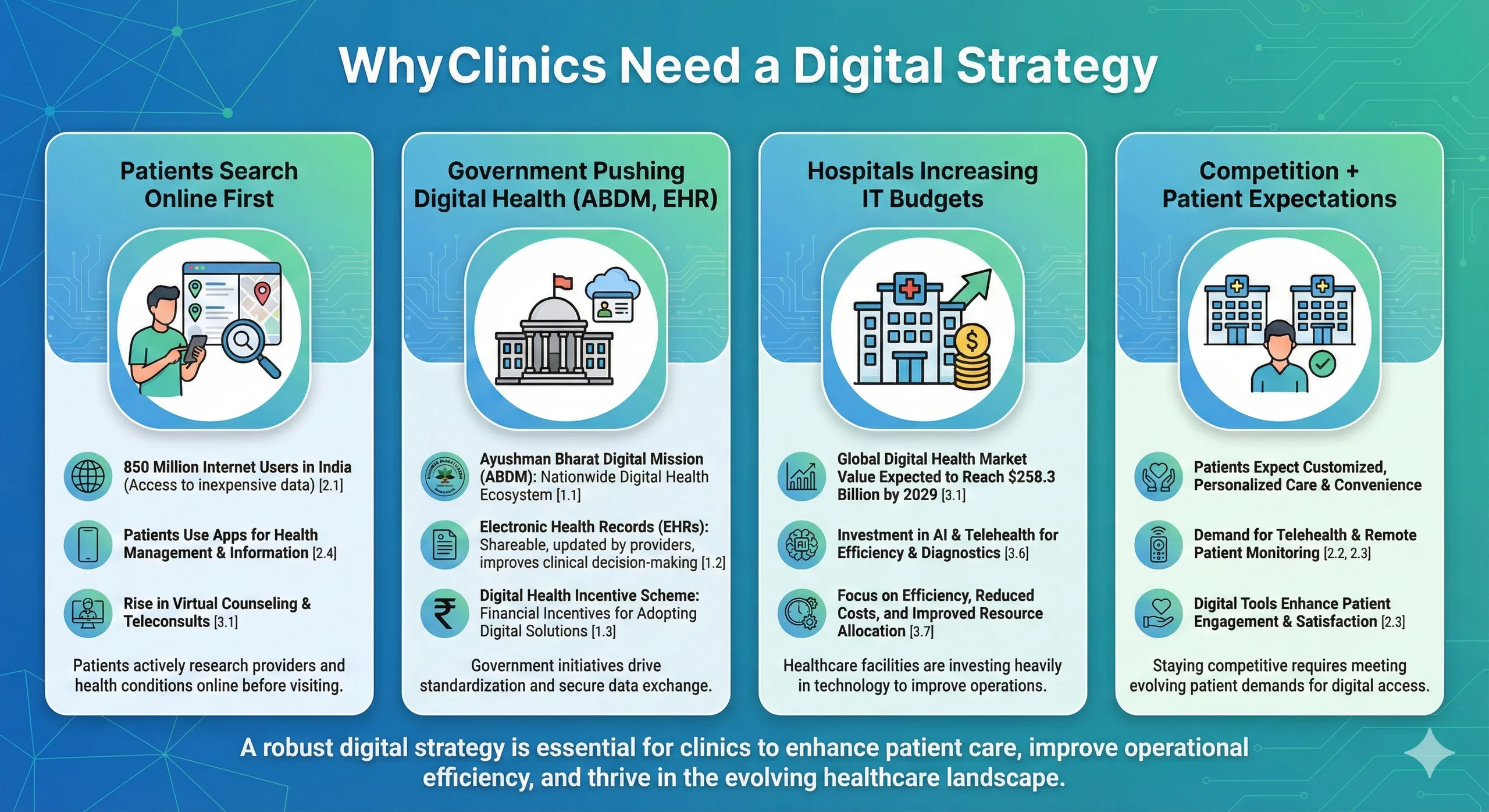
Patients now expect healthcare to work like other services they use daily: discover online, book online, pay online, and receive updates on their phone. If a clinic cannot offer this convenience, patients often choose another provider who can.?
Key reasons every clinic needs a digital strategy today:
- Patients search first, decide fastPlatforms and search engines heavily influence how patients find doctors and clinics.?A missing or weak online presence makes a new clinic almost invisible beyond its immediate neighborhood.?
- Platforms and search engines heavily influence how patients find doctors and clinics.?
- A missing or weak online presence makes a new clinic almost invisible beyond its immediate neighborhood.?
- Policy and ecosystem are going digitalNational programs are pushing for digital health records, interoperability, and secure data sharing in India.?Over the next few years, hospitals that align with digital standards will find it easier to integrate with insurance, labs, and government platforms.?
- National programs are pushing for digital health records, interoperability, and secure data sharing in India.?
- Over the next few years, hospitals that align with digital standards will find it easier to integrate with insurance, labs, and government platforms.?
- IT investment is shifting from luxury to necessityRecent reports show Indian hospitals increasing IT innovation budgets by around 20–25% over the next 2–3 years, focusing on automation and patient experience.?Clinics that delay digital adoption risk higher operational costs and weaker competitiveness against more modern providers.?
- Recent reports show Indian hospitals increasing IT innovation budgets by around 20–25% over the next 2–3 years, focusing on automation and patient experience.?
- Clinics that delay digital adoption risk higher operational costs and weaker competitiveness against more modern providers.?
In simple terms: digital transformation is now core business strategy, not just an IT project.
What is digital transformation for clinics and hospitals?
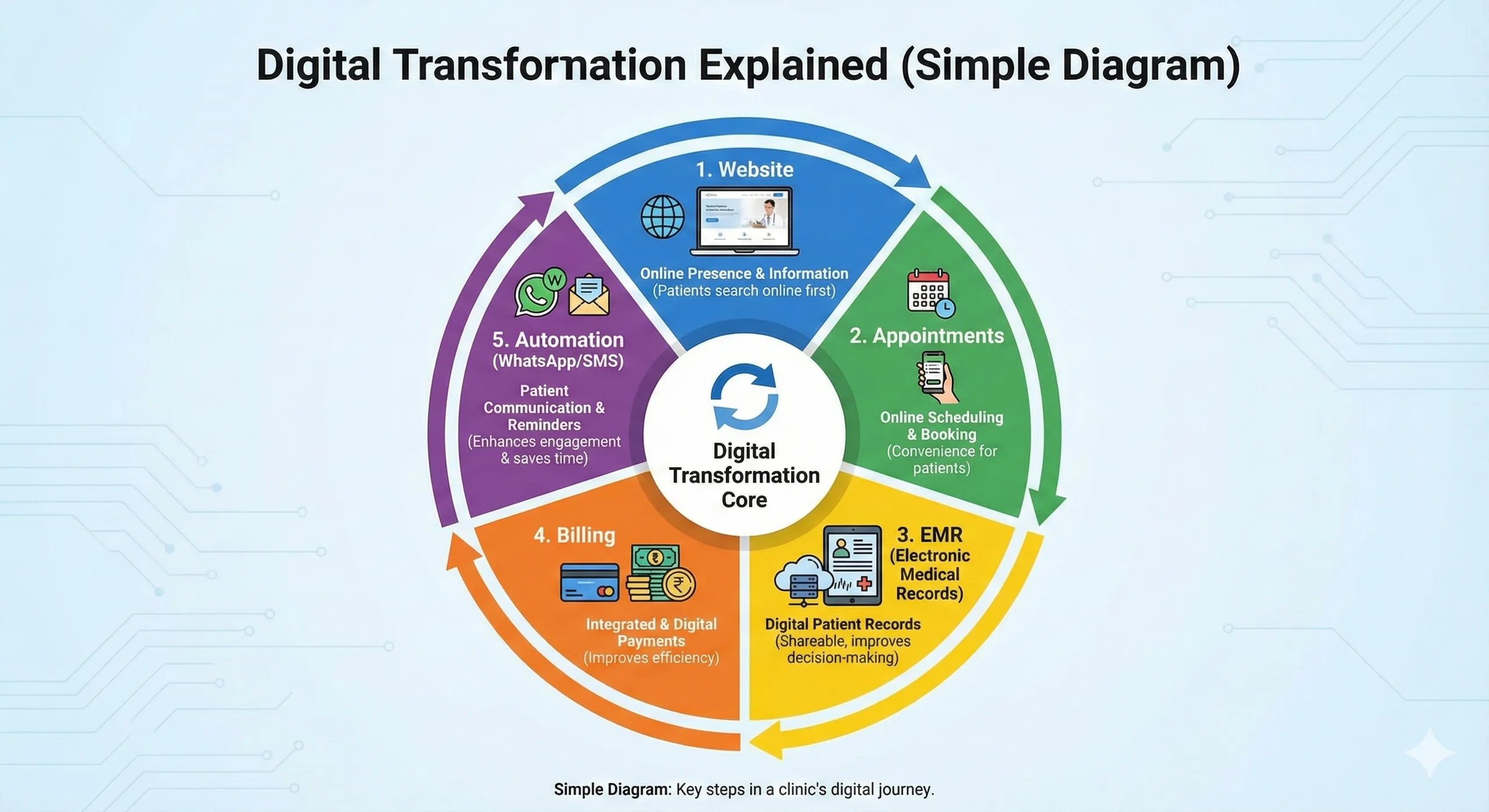
Digital transformation in healthcare means redesigning how a clinic or hospital works using technology so that care becomes more accessible, efficient, and patient-centric. It touches everything from appointments and billing to clinical documentation, communication, and analytics.?
For a new clinic or hospital, this usually starts with:
- A robust website and online presence
- Online appointment and enquiry systems
- Digital patient records (EMR) and basic hospital information systems
- WhatsApp and SMS automation for communication
- Online billing, payments, and reports
The goal is not to buy every tool at once, but to build a lean, integrated stack that supports growth, quality, and compliance.
Core components of digital transformation
Website: your digital “front desk”
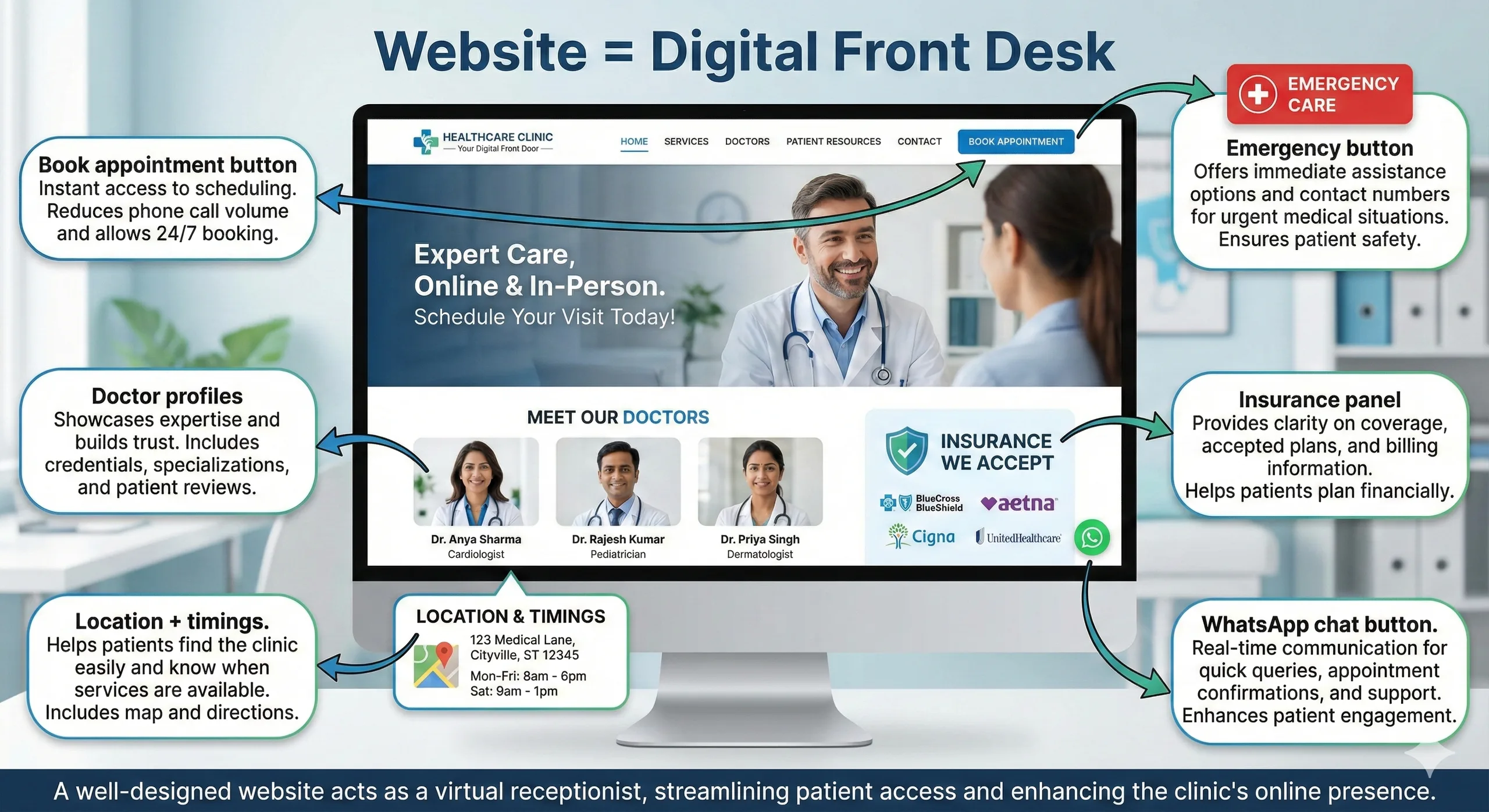
A clinic or hospital website is the main owned asset you control, unlike listings on third-party platforms. It acts as a 24/7 reception, information hub, and lead-conversion engine for patient enquiries.?
A good healthcare website should:
- Clearly show who you are and what you offerSpecialities, doctors, timings, locations, procedures, insurance panels, and emergency instructions.?
- Specialities, doctors, timings, locations, procedures, insurance panels, and emergency instructions.?
- Make it easy to take action“Book Appointment” buttons, WhatsApp click-to-chat, call buttons, and enquiry forms on key pages.?
- “Book Appointment” buttons, WhatsApp click-to-chat, call buttons, and enquiry forms on key pages.?
- Be optimized for mobile and searchMost patients search and browse on mobile, and search-friendly content helps you appear for local queries like “orthopedic clinic near me” or “child specialist in [city]”.?
- Most patients search and browse on mobile, and search-friendly content helps you appear for local queries like “orthopedic clinic near me” or “child specialist in [city]”.?
For new clinics, a professional website is often the difference between a slow start and a steady pipeline of appointments in the first year.?
Appointment system: from phone chaos to predictable schedules
Traditional walk-in and phone-based appointment management leads to:
- Overcrowding at certain times
- High no-show rates
- Heavy front-desk workload and patient frustration
Modern clinics increasingly use online appointment systems that let patients book, reschedule, and get automated reminders on mobile. Research shows most patients now prefer to book or manage appointments online when possible.?
Practical benefits:
- Slots are visible and controlled, reducing waiting time and staff confusion.?
- Automated reminders via SMS/WhatsApp reduce no-shows significantly.?
- For teleconsultations, patients can receive links and instructions within the booking journey.?
For a new hospital, integrating appointment booking across departments (OPD, diagnostics, imaging) ensures smoother patient flow from day one.?
Patient records: EMR as the clinical backbone
Electronic Medical Records (EMR) store patient clinical data like history, prescriptions, vitals, and reports in a structured, digital format. EMR systems reduce medication errors, improve continuity of care, and make it easier to track outcomes.?
Key EMR advantages:
- All patient data in one placeDoctors can quickly see previous visits, allergies, investigations, and treatment plans.?
- Doctors can quickly see previous visits, allergies, investigations, and treatment plans.?
- Better safety and efficiencyAutomated checks reduce errors, and standardized templates speed up documentation.?
- Automated checks reduce errors, and standardized templates speed up documentation.?
- Easier reporting and analyticsClinics can track disease patterns, follow-up rates, and clinical KPIs over time.?
- Clinics can track disease patterns, follow-up rates, and clinical KPIs over time.?
For a small clinic, starting with a cloud-based clinic management system that combines appointments, EMR, and billing is often the most cost-effective route.?
EMR vs ERP for hospitals
Many hospital founders confuse EMR and ERP or assume they are the same. They serve different purposes and often integrate with each other.?
- EMR (Electronic Medical Record)Focus: Patient clinical data and care workflows.Users: Doctors, nurses, clinical staff.Examples of features: OPD documentation, prescriptions, clinical notes, lab results, radiology reports.?
- Focus: Patient clinical data and care workflows.
- Users: Doctors, nurses, clinical staff.
- Examples of features: OPD documentation, prescriptions, clinical notes, lab results, radiology reports.?
- ERP (Enterprise Resource Planning) or full Hospital Information System (HIS)Focus: Operational, financial, and administrative management of the hospital.?Users: Management, finance, HR, inventory, operations teams.Examples of features: Billing, inventory, pharmacy, HR, payroll, fixed assets, procurement, sometimes integrated EMR modules.?
- Focus: Operational, financial, and administrative management of the hospital.?
- Users: Management, finance, HR, inventory, operations teams.
- Examples of features: Billing, inventory, pharmacy, HR, payroll, fixed assets, procurement, sometimes integrated EMR modules.?
For most new hospitals:
- Start with:A robust HIS/ERP that includes billing, pharmacy, inventory, and basic patient administration.An EMR module or integrated EMR that doctors will actually use daily.
- A robust HIS/ERP that includes billing, pharmacy, inventory, and basic patient administration.
- An EMR module or integrated EMR that doctors will actually use daily.
The right balance is a system where clinical and administrative modules share data but are simple enough for staff to adopt.
WhatsApp automation: where your patients already are
In India, WhatsApp is often the default communication channel for patients. Clinics and hospitals are increasingly integrating WhatsApp Business and APIs into their systems to handle routine communication automatically.?
WhatsApp automation can help with:
- Appointment confirmations and remindersAutomated messages after booking, with date/time, location, and links for directions.?
- Automated messages after booking, with date/time, location, and links for directions.?
- Test reports and instructionsSecure links to reports, preparation guidelines, and follow-up instructions where policy allows.?
- Secure links to reports, preparation guidelines, and follow-up instructions where policy allows.?
- Feedback and reviewsQuick feedback forms post-visit help improve quality and increase online ratings.?
- Quick feedback forms post-visit help improve quality and increase online ratings.?
- Basic FAQs and triageChatbots can answer simple questions and hand over to staff for complex issues.?
- Chatbots can answer simple questions and hand over to staff for complex issues.?
This reduces phone traffic, improves patient satisfaction, and keeps your brand top-of-mind without adding more staff.?
Online billing and payments: faster collections, fewer queues
Patients are increasingly comfortable paying healthcare bills digitally and, in many cases, prefer it. Integrating online payment options with your appointment and billing systems has multiple benefits.?
Advantages include:
- Faster checkoutPatients can pay before or immediately after consultation, reducing cash handling and waiting times.?
- Patients can pay before or immediately after consultation, reducing cash handling and waiting times.?
- Better tracking and reconciliationFinance teams get clear records and automated reports with fewer manual errors.?
- Finance teams get clear records and automated reports with fewer manual errors.?
- Support for telehealth and remote servicesOnline payments are essential when consultations or services happen virtually.?
- Online payments are essential when consultations or services happen virtually.?
For new hospitals, getting this foundation right improves cash flow and prepares you for insurance and corporate billing integrations later.
How a hospital can save ?5–15 lakhs per year using digital tools
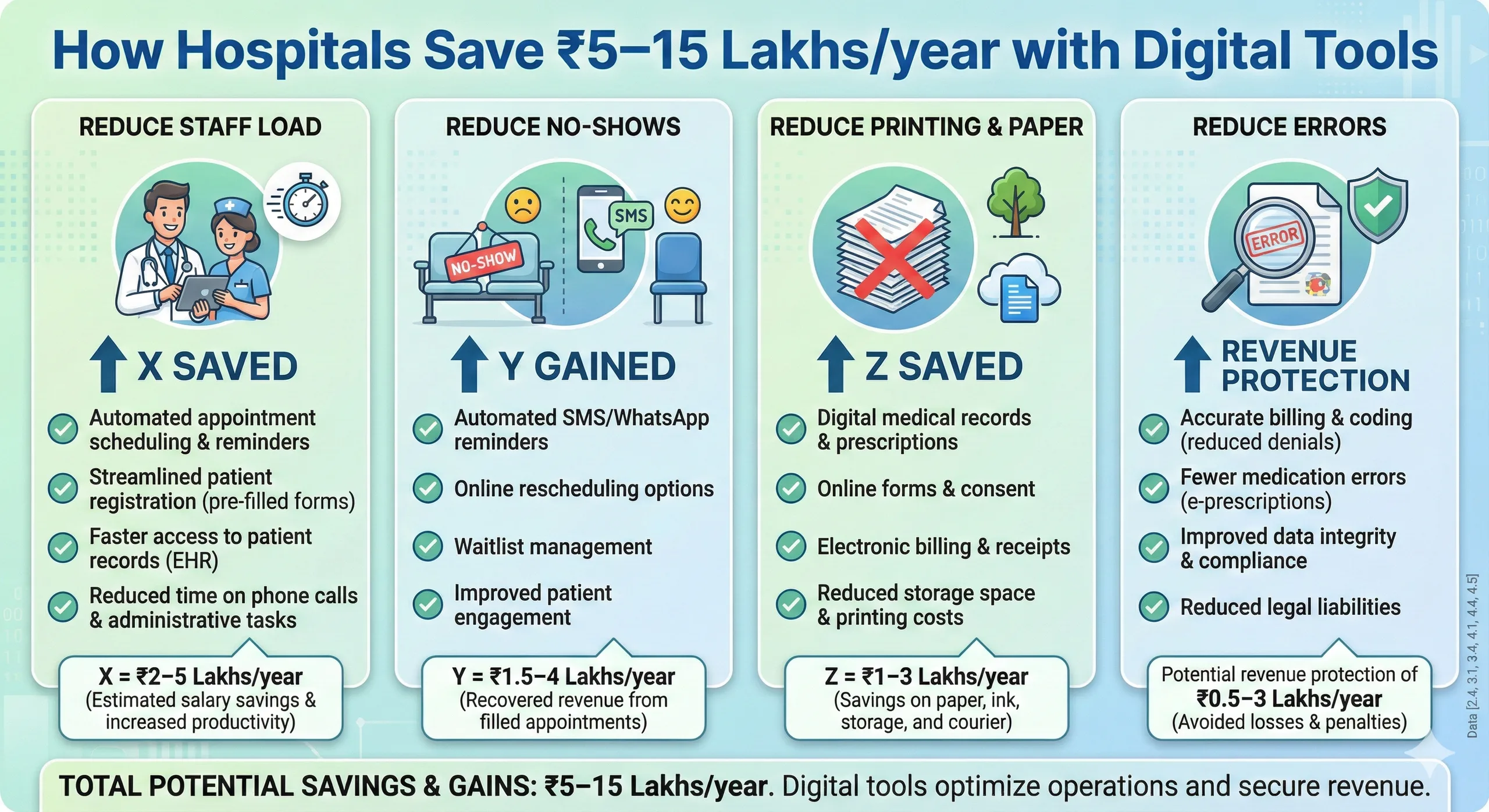
Digital transformation is often seen as a cost, but for a new hospital it can quickly turn into net savings and additional revenue.
Here is a realistic, conservative view of how savings add up over a year for a small–mid-size hospital:
- Front-desk and call-center optimizationOnline booking and WhatsApp automation can reduce call volume and manual follow-up, often saving the equivalent of 1–2 full-time staff salaries per year.?At typical Indian salary levels, that alone can reach several lakhs annually.
- Online booking and WhatsApp automation can reduce call volume and manual follow-up, often saving the equivalent of 1–2 full-time staff salaries per year.?
- At typical Indian salary levels, that alone can reach several lakhs annually.
- Reduced no-shows and better slot utilizationAutomated reminders via SMS/WhatsApp significantly reduce missed appointments.?Even a small improvement in attendance translates into more billed consultations and procedures across OPD and diagnostics.
- Automated reminders via SMS/WhatsApp significantly reduce missed appointments.?
- Even a small improvement in attendance translates into more billed consultations and procedures across OPD and diagnostics.
- Paper, printing, and storage reductionMoving to EMR and digital billing reduces the need for physical files, registers, and printouts.?Over time, this saves on paper, storage space, and file management manpower.
- Moving to EMR and digital billing reduces the need for physical files, registers, and printouts.?
- Over time, this saves on paper, storage space, and file management manpower.
- Fewer errors and revenue leakagesIntegrated billing and inventory reduce mistakes in charge capture and stock losses.?Structured workflows prevent under-billing or missed procedures.
- Integrated billing and inventory reduce mistakes in charge capture and stock losses.?
- Structured workflows prevent under-billing or missed procedures.
When these effects are combined, clinics and hospitals can realistically save or earn an extra ?5–15 lakhs per year, depending on size and patient volume, while also improving patient experience and staff satisfaction.
Patient journey mapping: offline vs digital
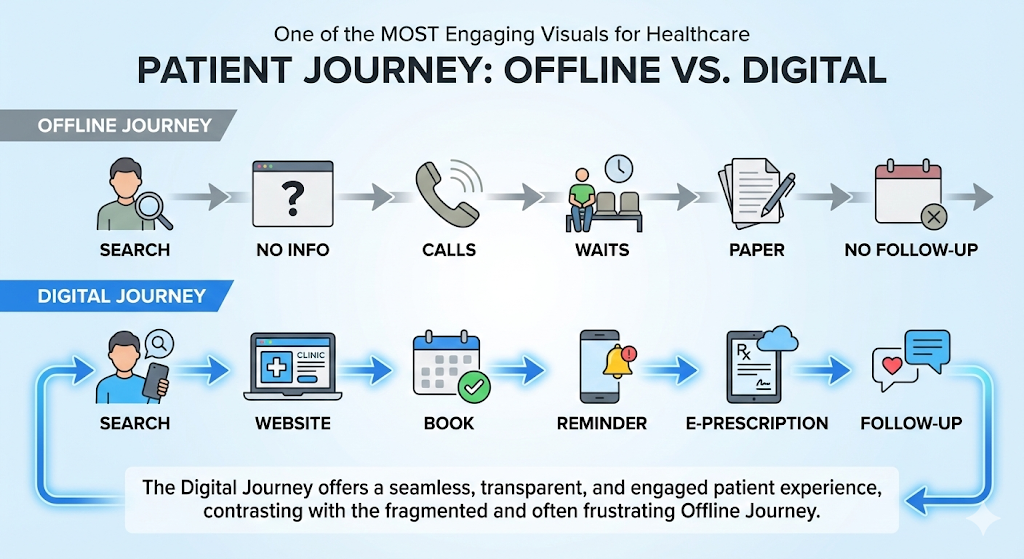
Understanding the patient journey is crucial to designing your digital transformation roadmap.
A typical offline journey:
- Patient hears about the clinic via word of mouth.
- Searches for the name, but finds incomplete Google results or no website.
- Calls repeatedly to confirm timings; faces busy lines.
- Visits as a walk-in, fills paper forms, waits for a long time.
- Collects paper prescription and reports; no systematic follow-up.
A digitally enabled journey:
- Patient searches for symptoms or speciality and finds your website or profile with clear details.?
- Checks doctor timings, services, fees, and reviews directly online.?
- Books a convenient slot via website or WhatsApp and receives instant confirmation and reminders.?
- On arrival, pre-filled details or QR-based check-in reduce paperwork and waiting.?
- Receives digital prescription, online reports, and follow-up reminders.?
By mapping your current patient journey and overlaying digital touchpoints, management teams can prioritize where to invest first for maximum impact.
Website benefits for clinics and hospitals
A well-designed, medically appropriate website can be one of the highest ROI investments for new clinics.
Key benefits include:
- Stronger trust and positioningPatients perceive professional websites as a sign of seriousness and modern standards of care.?Profiles for doctors, clear service descriptions, and transparent policies increase confidence.
- Patients perceive professional websites as a sign of seriousness and modern standards of care.?
- Profiles for doctors, clear service descriptions, and transparent policies increase confidence.
- More qualified patient enquiriesYour website filters and educates visitors before they contact you, leading to enquiries that are better matched to your services.?Integrated forms, chatbots, and WhatsApp buttons convert visitors into booked appointments more efficiently.?
- Your website filters and educates visitors before they contact you, leading to enquiries that are better matched to your services.?
- Integrated forms, chatbots, and WhatsApp buttons convert visitors into booked appointments more efficiently.?
- Better support for AEO (Answer Engine Optimization)Structured content that answers common patient questions helps search and AI assistants surface your clinic as a relevant option in voice and text queries.?
- Structured content that answers common patient questions helps search and AI assistants surface your clinic as a relevant option in voice and text queries.?
- Control compared to third-party platformsWhile aggregator platforms are useful, an owned website ensures your brand, information, and leads stay under your control.?
- While aggregator platforms are useful, an owned website ensures your brand, information, and leads stay under your control.?
For specialty clinics (dental, fertility, orthopaedic, dermatology, etc.), websites also enable patient education blogs and treatment explainer pages that build authority over time.?
Is a website necessary for hospitals?
In practical terms, yes, especially for new hospitals that need to build awareness and trust quickly.
Reasons a website is now essential:
- Hospitals are complex, and patients need clarityDepartments, doctors, insurance tie-ups, packages, and emergency services all need a central, reliable source of truth.?
- Departments, doctors, insurance tie-ups, packages, and emergency services all need a central, reliable source of truth.?
- Corporate, international, and referral partners expect itReferring doctors, corporations, and insurers typically check a hospital’s website before initiating deeper engagement.?
- Referring doctors, corporations, and insurers typically check a hospital’s website before initiating deeper engagement.?
- It is the base for all other digital toolsOnline booking, chatbots, patient portals, and information security frameworks usually connect back to your main website.?
- Online booking, chatbots, patient portals, and information security frameworks usually connect back to your main website.?
For hospitals, the website is best treated as core infrastructure, not a marketing side project.
What tools should a new hospital or clinic use?
For a new setup, it is important to start with a lean, high-impact toolkit rather than buying everything at once.
Priority tools:
- Clinic or hospital website with online appointment integration.?
- Clinic/Hospital Management System (HMS/HIS) with EMR, billing, and inventory.?
- WhatsApp Business with automation through an approved provider or integration with your HMS.?
- Online payment gateway linked to billing and appointment systems.?
- Basic analytics: website analytics, call tracking, and simple dashboards from your HMS to monitor volumes, revenue, and patient satisfaction.?
As operations stabilize, you can explore:
- Telemedicine platforms
- AI chatbots on the website for triage and FAQs
- CRM tools for chronic care, preventive health packages, and follow-up campaigns.?
How to build an online presence for a clinic
Going “digital” starts with being easily discoverable and trustworthy online.
Steps to build your online presence:
- Secure your domain and hostingChoose a clear, short domain that reflects your clinic or hospital name and city where possible.?
- Choose a clear, short domain that reflects your clinic or hospital name and city where possible.?
- Launch a professional websiteFocus on core pages: Home, Doctors, Specialities, Services/Procedures, Timings & Location, Book Appointment, Contact, and FAQs.?
- Focus on core pages: Home, Doctors, Specialities, Services/Procedures, Timings & Location, Book Appointment, Contact, and FAQs.?
- Optimize your Google Business ProfileAdd correct address, contact details, photos, and link your website.?Encourage genuine patient reviews over time.
- Add correct address, contact details, photos, and link your website.?
- Encourage genuine patient reviews over time.
- Ensure consistent branding across platformsUse the same name, logo, and key information on your website, maps, directories, and social media.?
- Use the same name, logo, and key information on your website, maps, directories, and social media.?
- Add content that answers patient questionsShort blogs, FAQ sections, and procedure explainers position the clinic as an expert and help with search visibility.?
- Short blogs, FAQ sections, and procedure explainers position the clinic as an expert and help with search visibility.?
This combination of website, local SEO, and basic content is usually sufficient for a strong start in the first year.
What is EMR / OPD software in simple terms?
EMR/OPD software is the digital equivalent of your patient files and OPD registers, wrapped in workflows doctors can use during consultations.?
Typical features:
- Electronic patient profiles with demographics, history, and visit records.?
- OPD notes, prescriptions, investigations ordered, and follow-up plans.?
- Integration with lab, radiology, and pharmacy modules to reduce manual work.?
For doctors, the key is that the software should be fast to use in real consultations, with simple templates and minimal clicks, rather than overloaded with unnecessary complexity.
How to get more patient enquiries using digital systems
Digital tools become powerful when they are configured to convert interest into appointments consistently.
Practical ways to increase patient enquiries:
- Place clear CTAs across your digital presence“Book Appointment”, “Request Call Back”, and “WhatsApp Us” should be visible on every key page of your website.?
- “Book Appointment”, “Request Call Back”, and “WhatsApp Us” should be visible on every key page of your website.?
- Add an AI or rules-based chatbotA basic chatbot on your website can handle common questions and book appointments round the clock.?Some implementations have shown substantial increases in online appointments by removing friction in the booking process.?
- A basic chatbot on your website can handle common questions and book appointments round the clock.?
- Some implementations have shown substantial increases in online appointments by removing friction in the booking process.?
- Use WhatsApp and email follow-upsAfter a first visit, automated follow-ups for reports, reviews, or preventive packages keep you top-of-mind.?
- After a first visit, automated follow-ups for reports, reviews, or preventive packages keep you top-of-mind.?
- Track and refineUse simple analytics to see which pages or campaigns generate enquiries and invest more in what works.?
- Use simple analytics to see which pages or campaigns generate enquiries and invest more in what works.?
Over time, this turns your digital assets into a predictable engine for new and repeat patients.
How to choose the right website developer for healthcare
Healthcare websites have specific requirements: sensitivity of information, medical accuracy, consent, and integration with systems. When choosing a website partner, focus less on flashy portfolios and more on fit-for-purpose capabilities.
Key evaluation points:
- Understanding of healthcare workflows and terminologyThe team should be comfortable working with medical content, departments, OPD/IPD, and regulatory context.?
- The team should be comfortable working with medical content, departments, OPD/IPD, and regulatory context.?
- Technical readiness for integrationAbility to integrate appointment systems, payment gateways, chatbots, and basic HIS/HMS tools securely.?
- Ability to integrate appointment systems, payment gateways, chatbots, and basic HIS/HMS tools securely.?
- Performance, security, and compliance awarenessOptimized page speed, mobile-first design, SSL, and basic data protection practices are essential.?
- Optimized page speed, mobile-first design, SSL, and basic data protection practices are essential.?
- Support and maintenanceHealthcare websites need ongoing updates for timings, doctors, packages, and campaigns; ensure the agency can support long-term.?
- Healthcare websites need ongoing updates for timings, doctors, packages, and campaigns; ensure the agency can support long-term.?
- Content and SEO approachThe developer should help structure content so that common patient questions are answered clearly and in a search-friendly way.?
- The developer should help structure content so that common patient questions are answered clearly and in a search-friendly way.?
A premium partner will think beyond design and focus on how the website supports patient experience, operations, and growth.
Checklist for new clinics to go digital
Use this practical checklist when planning your clinic or new hospital launch:
- Foundation
- Decide your brand name, domain, and basic positioning (specialities, target audience, geography).
- Allocate a realistic digital budget for year one (website, HMS/EMR, communication tools).
- Website and online presence
- Register domain and set up secure hosting.
- Build a mobile-first website with clear CTAs and doctor/speciality pages.
- Create or claim Google Business Profile with accurate details.
- Clinic/Hospital management systems
- Select a cloud-based HMS/clinic management system with appointments, EMR, and billing.
- Configure departments, doctors, services, and fee structures.
- Train front-desk and clinical staff before launch.
- Communication and automation
- Set up WhatsApp Business and integrate with appointment/billing systems where possible.
- Configure SMS/WhatsApp reminders for appointments and follow-ups.
- Draft standard templates for confirmations, reminders, and feedback requests.
- Payments and reporting
- Integrate a payment gateway for online consultations and advance payments.
- Set up daily, weekly, and monthly reports for patient volume, revenue, and no-show rates.
- Content and reputation
- Prepare basic FAQ and patient education content for your website.
- Encourage genuine patient feedback and respond politely to reviews.
- Periodically add blogs or updates on relevant health topics.
Working through this checklist in phases ensures your clinic or hospital becomes digitally ready without overwhelming your team.
If you are planning a new clinic or hospital or modernizing an existing one and want a practical, healthcare-focused digital roadmap, TenG Spectrum can help you implement the right website, patient systems, and automation without complexity. Connect with TenG Spectrum today to plan a premium, future-ready digital presence that actually supports patient care and business growth.

Frequently Asked Questions
Find quick answers to common questions about this topic