The Legal Framework for Digital Patient Consent
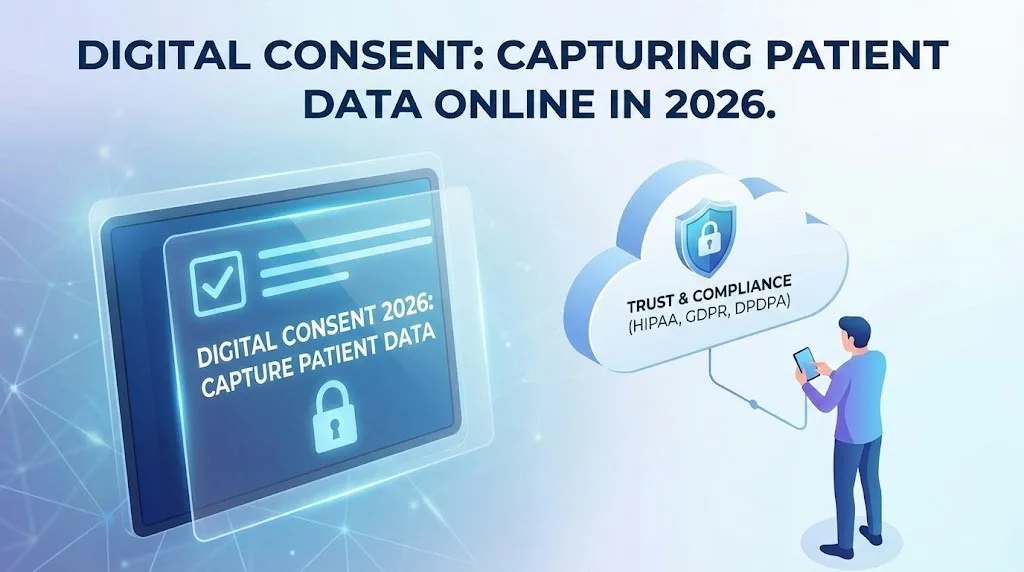
In 2026, legally capturing patient data online requires an integrated approach that combines explicit consent mechanisms with high-level technical encryption. To remain compliant with modern standards like HIPAA’s February 2026 updates and the Global Data Protection Regulation (GDPR), providers must utilize unbundled, specific authorization forms that separate medical treatment consent from secondary data uses such as marketing or research.
10 Ways Hospitals Improve Patient Experience via Digital Touchpoints (2026 Guide)
The Shift Toward Granular Authorization
The regulatory landscape of 2026 has moved past generic "I agree" checkboxes. Under the updated HIPAA Privacy Rule, healthcare entities must now provide specific notices regarding reproductive health privacy and data portability.2 Digital forms are no longer just administrative tools; they are legal fiduciaries. This means every form must clearly state the purpose of data collection, the duration of storage, and the patient's right to revoke access at any time.
How to Build a Hospital Website: The Complete 2026 Guide for Healthcare Leaders
Technically, the "Answer-First" model for data capture prioritizes security by design. Frameworks like Python/Django or robust WordPress environments must implement end-to-end encryption specifically TLS for data in transit and AES-256 for data at rest. Furthermore, the 2026 standard for patient portals includes mandatory Multi-Factor Authentication (MFA) and immutable audit logs to track every instance of data access, satisfying both federal audits and patient trust requirements.
Technical Checklist for 2026 Compliance
To ensure your online patient forms meet current legal and technical benchmarks, implement the following structural elements:
- Encryption Standards: Utilize TLS 1.3 for transmission and AES-256 for database storage.
- Unbundled Consent: Provide separate toggle switches for "Terms of Service," "Notice of Privacy Practices," and "Third-Party Data Sharing."
- Active Opt-In: Ensure all consent boxes are unchecked by default to meet GDPR and CCPA "explicit consent" requirements.
- Mobile Accessibility: Maintain WCAG 2.1 Level AA compliance to ensure forms are navigable for patients with visual or cognitive impairments.
- Revocation Pathway: Include a direct, digital link within the patient portal that allows users to withdraw consent as easily as they provided it.
| Requirement Category | 2026 Standard | Implementation Method |
| Data Transit | TLS 1.3 / HTTPS | Secure SSL Certificate Configuration |
| User Identity | Multi-Factor (MFA) | SMS/TOTP Integration on Form Submission |
| Privacy Notice | Updated NPP 2026 | Explicit Modal Popup before Data Entry |
Frequently Asked Questions
Find quick answers to common questions about this topic