Understanding Bot Traffic: A Complete Guide for Modern Businesses
Bot traffic refers to any non-human visits to your website or app generated by automated software programs. These bots can interact with your pages, APIs, login forms, search, and even checkout flows—just like real visitors, but without a human behind the screen.
Today, nearly half of all internet traffic comes from bots, and a large portion consists of malicious bots. This makes bot management a critical part of your website’s security, performance, and digital strategy.
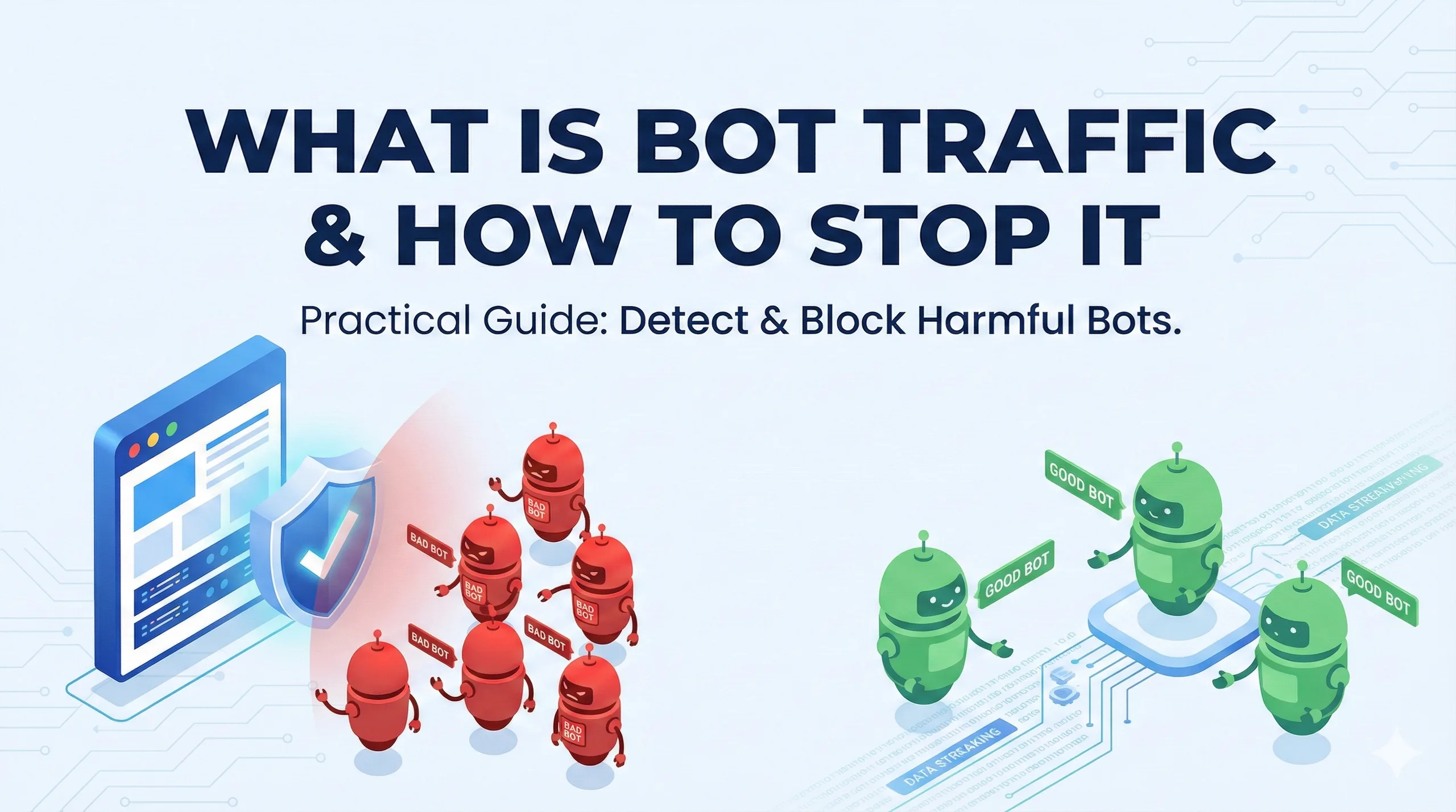
Good Bots vs Bad Bots
Not all bot traffic is harmful. The first step in bot management is distinguishing between good and bad bots.
Examples of Good Bots
Good bots identify themselves clearly, follow rules like robots.txt, and generally help your website function better. Common examples include:
- Search engine crawlers such as Googlebot and Bingbot that help with SEO.
- Monitoring bots that track uptime, speed, and broken links.
- Integration bots from social media or partner platforms.
These bots improve your discoverability and reliability.
Examples of Bad Bots
Bad bots hide their identity, fake human behavior, and bypass security systems. They are used for:
- Credential stuffing and account takeover
- Large-scale scraping of content or pricing
- Carding attacks on checkout pages
- Click fraud and analytics pollution
- DDoS attacks
These bots can drain revenue, harm your brand, and distort your analytics.
Good vs Bad Bots at a Glance
| Aspect | Good Bots | Bad Bots |
|---|---|---|
| Purpose | Indexing, monitoring, integrations | Fraud, scraping, DDoS, fake traffic |
| Behavior | Predictable, follow robots.txt | Mimic humans, hide identity |
| Identity | Known user agents & IPs | Spoofed agents, rotating proxies |
| Impact | Better SEO & reliability | Revenue loss, security risk, bad analytics |
| Approach | Allowlist & monitor | Detect, rate-limit, challenge, block |
Why Bot Traffic Matters to Your Business
Regardless of whether you run a clinic, boutique store, ecommerce brand, or service business, bot traffic directly affects your bottom line.
Key impacts include:
- Distorted analytics leading to wrong decisions.
- Slow website performance due to wasted server resources.
- Security threats from credential stuffing or data theft.
- Revenue loss through fake traffic, inflated ad spend, and inventory hoarding.
For high-performing websites—like the ones TenG Spectrum builds—uncontrolled bot traffic can erase the conversion gains you worked hard to achieve.
Types of Bot Traffic
Understanding different types of bots helps you design a targeted protection strategy.
1. Crawler and Indexer Bots
Purpose: Discover and index your content for search engines.
Signs: Standard user agents, regular crawl patterns, robots.txt compliance.
Recommendation: Allow them and manage with sitemaps and crawl rules.
2. Monitoring and Utility Bots
These help keep your site healthy—uptime monitors, API checkers, link scanners.
Recommendation: Allowlist trusted services but cap aggressive scanning.
3. Scraper and Competitive Intelligence Bots
These bots steal:
- Pricing
- Product catalogs
- Reviews
- Proprietary content
Signs include high page views from a single IP and ignoring robots.txt.
Recommendation: Rate-limit, block, and protect key URLs.
4. Fraud, Spam, and Brute-Force Bots
High-risk category responsible for:
- Credential stuffing
- Card testing
- Spamming forms and reviews
These require immediate security controls.
5. DDoS and Volumetric Bots
Goal: Overwhelm your website with traffic until it crashes.
Targets: Checkout, login, search, APIs, or entire homepages.
Recommendation: Use WAF/CDN with DDoS protection.
How to Detect Bot Traffic
Bot detection is about combining signals to identify patterns.
Technical signs
- Sudden abnormal traffic spikes
- Suspicious or incomplete user-agent strings
- Unrealistic behavior (very low time on site, rapid navigation)
- Concentrated hits on login, cart, or payment pages
Analytics and logs
Use both Google Analytics and server/CDN logs. Check for:
- Traffic from unwanted geographies
- Sessions that do not load images or JS (headless bots)
- Conversion funnels with sudden drops
TenG Spectrum often integrates deeper analytics so business owners can understand bot impact without technical expertise.
How to Stop Bad Bot Traffic (Step-by-Step)
Effective bot mitigation is about precision, not blindly blocking everything.
Step 1: Classify and Prioritize
Identify your highest-risk areas:
- Login
- Patient portal
- Checkout
- Booking forms
- Lead forms
Start with what affects revenue and security most.
Step 2: Use a Web Application Firewall (WAF)
A modern WAF:
- Blocks malicious IPs and botnets
- Protects against DDoS
- Enforces rate limiting
- Filters user-agent patterns
For most SMEs, enabling a good WAF instantly reduces harmful bot traffic.
Step 3: Implement CAPTCHAs & Human Verification
Use CAPTCHAs on:
- Login
- Sign-up
- Password reset
- Checkout
- Comment forms
Invisible CAPTCHAs keep UX smooth while blocking bots.
Step 4: Rate Limiting and Throttling
Limit requests by IP/session:
- Slow down suspicious users
- Prevent brute-force attacks
- Discourage scrapers
Step 5: Bot Fingerprinting & Behavior Analysis
Advanced systems analyze:
- Browser fingerprints
- Mouse movement patterns
- Typing cadence
- Navigation speed
This helps catch sophisticated bots using residential proxies.
Step 6: Honeypots & Deception
Use hidden fields or URLs that real users never touch. Bots fall for them instantly.
Step 7: Maintain Dynamic Allowlists & Blocklists
- Allowlist Google, Bing, uptime monitors, etc.
- Block known malicious IP ranges, data centers, or unnecessary geographies.
Bots evolve, so rules must be reviewed regularly.
Real-World Bot Problems by Industry
Healthcare
- Scraping doctor profiles or medical content
- Spam in appointment/contact forms
- Credential stuffing on patient portals
Hospitality
- Price scraping by competitors or OTAs
- Carding attacks during checkout
- DDoS before peak seasons
MSMEs & Ecommerce
- Card testing
- Fake ad traffic wasting budget
- Scraping product descriptions
Without protection, small businesses become easy targets.
Best Practices: Protecting Your Site Without Hurting SEO
The goal is balance—protect your business while keeping discoverability strong.
Key rules:
- Preserve good bots: Allow search engines and partners.
- Protect high-risk endpoints: Login, checkout, bookings.
- Monitor continuously: Track failed logins, unusual spikes, suspicious geographies.
- Align with SEO & conversion goals: Don’t block essential crawlers.
A well-architected system ensures security + performance + SEO work together.
When to Bring in an Expert
Sophisticated bots require a more advanced, integrated approach. Manual blocking is no longer enough.
TenG Spectrum can help you:
- Build a fast, secure, conversion-optimized website
- Implement WAF, CDN, and bot mitigation tools
- Maintain clean analytics for better decision-making
- Protect SEO & AEO while blocking harmful traffic
If your website shows signs of inflated traffic, reduced speed, form spam, or security warnings—it's time to act.
Reach out to TenG Spectrum today to audit your current website, harden it against abusive bots, and build a digital presence that is fast, trustworthy, and ready for the next generation of search and AI-driven experiences.?