Introduction: The Digital Crossroads Every Business Faces
Your business is growing. You have a great product, a dedicated team, and ambitious goals. Now, you need a digital storefront a website that not only looks good but performs flawlessly. You've reached a critical crossroads: do you use a popular Do-It-Yourself (DIY) website builder like Wix, Squarespace, or Shopify, or do you invest in professional, custom development?
While DIY platforms promise a quick and cheap solution, they often hide long-term costs and limitations that can cripple a growing business. In our experience, many clients come to us after their DIY site has hit a wall they can't break through. This guide is designed to give you a clear, authoritative breakdown of both paths so you can choose the right foundation for your digital future.
The Allure of DIY: A Starting Point, Not a Destination
Let's be fair DIY website builders have their place. They offer clear advantages for a specific type of user.
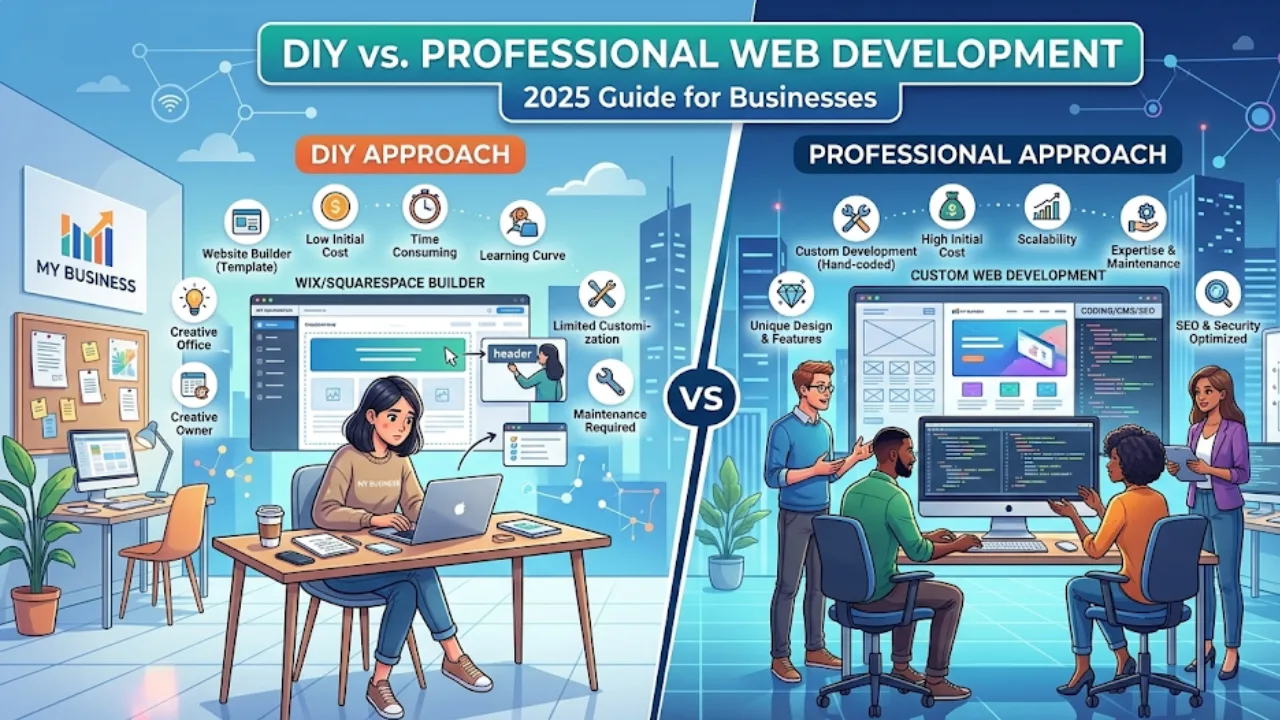
- Low Initial Cost: For a few hundred rupees a month, you can get a site online. It's an attractive entry point for hobbyists or businesses testing an idea with a minimal budget.
- Speed to Launch: Using pre-made templates, you can launch a basic website in a weekend without writing a single line of code.
- Simplicity: The drag-and-drop interfaces are designed for absolute beginners.
However, the very simplicity that makes them attractive is also the source of their greatest weaknesses for any business serious about growth.
The Hidden Dangers of DIY: Why "Good Enough" Isn't Enough
A DIY website is like renting a small, furnished apartment. It's convenient at first, but you can't knock down walls, upgrade the plumbing, or truly make it your own. Professional development is like building your own custom house on a solid foundation it's built to last and grow with you.
1. The Scalability Trap
This is the number one reason businesses outgrow their DIY sites. As your traffic increases, you add more products, or you need complex features (like a custom client portal or API integration), the DIY platform's rigid infrastructure breaks down.
- Performance Bottlenecks: DIY sites run on shared infrastructure. A surge in your traffic or a clunky plugin can slow your site to a crawl, killing your conversion rates and SEO ranking.
- Feature Ceilings: Need a specific inventory management system or a unique booking process? On a DIY platform, you are limited to their app store. If the feature doesn't exist, you can't build it. Custom development has no such limits.
2. The Myth of True Ownership
You don't own your DIY website; you rent space on a platform.
- Data Lock-In: Migrating your content, customer data, and order history away from platforms like Shopify or Wix can be incredibly difficult, if not impossible. Your business's most valuable digital asset is effectively held hostage.
- Platform Risk: If the platform changes its pricing, terms of service, or shuts down a key feature, your business is at its mercy. With a custom-built site, you own the code, the data, and the hosting. You are in complete control.
3. The "Glass Box" of Customisation and Branding
DIY templates can look clean, but they are generic. Your website will look like thousands of others, making it impossible to build a strong, memorable brand identity. You can change colors and fonts, but you can't change the fundamental structure or user experience to match your unique brand journey.
4. The SEO Ceiling
While DIY builders have improved their basic SEO features, they cannot compete with the technical precision of a custom-built site.
- Code Bloat: Template-based code is often bloated and inefficient, which can harm your Core Web Vitals and search rankings.
- Structured Data Limitations: Implementing advanced schema markup for rich snippets and Answer Engine Optimisation (AEO) is often difficult or impossible, limiting your visibility in modern search results.
The Power of Professional Development: Building a Digital Asset
Investing in professional development isn't an expense; it's the creation of a valuable, long-term business asset that drives growth.
- Infinite Scalability & Performance: A custom site is built on a framework (like Django or a custom WordPress build) designed to handle your specific traffic and feature needs. It's engineered for speed and reliability from day one.
- Limitless Customisation: Every pixel, user flow, and feature is designed to serve your business goals and create a unique brand experience. If you can dream it, we can build it.
- True Ownership & Control: You own 100% of your website's code and data. It's a portable, valuable asset that you can host anywhere and modify anytime.
- Expert SEO & AEO Strategy: We build sites with a search-first approach, ensuring clean code, optimal site architecture, and advanced technical SEO are baked in from the start, giving you a competitive edge.
Conclusion: Choose a Foundation Built for Your Future
The choice between DIY and professional development comes down to your ambition.
A DIY website builder is a tool for starting. A professionally developed website is a platform for growing.
For any business, MSME, or startup that is serious about scaling, building a credible brand, and owning its digital future, the initial convenience of a DIY builder is a short-term gain that leads to long-term pain.
Frequently Asked Questions
Find quick answers to common questions about this topic