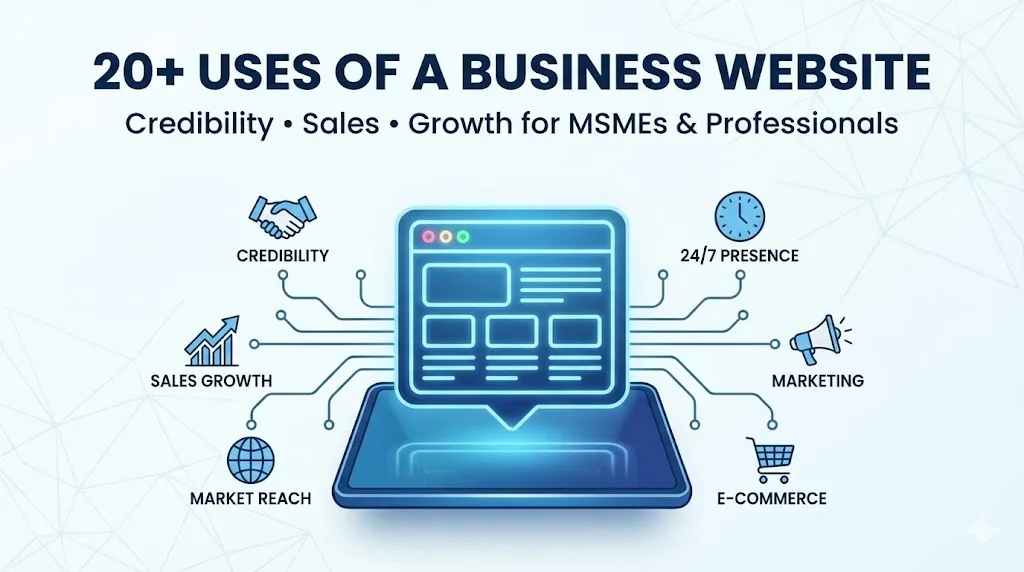
The Strategic Importance of a Digital Identity
In the current commercial landscape, the question is no longer whether a business should be online, but how effectively it presents itself. A website serves as the central nervous system of a modern brand. It is the only digital asset that a business truly owns and controls entirely, unlike social media profiles that are subject to third-party algorithm changes.
A website acts as a digital storefront that never closes. For a local medical clinic, a small-scale manufacturer, or a growing MSME, a website represents legitimacy. It provides a platform to communicate values, showcase products, and engage with a global audience without the geographical constraints of a physical office.
Understanding the use of a website requires looking beyond simple aesthetics. It is a multi-functional tool designed to solve business problems, automate manual tasks, and generate revenue. This guide explores the comprehensive uses and benefits of maintaining a professional business website.
How TenG Spectrum Drives Digital Growth for Traditional Businesses
1. Establishing Professional Credibility and Trust
One of the primary uses of a website is to establish authority. In an era where consumers research every purchase, a business without a website is often perceived as less professional or even non-existent.
The Trust Factor
A professional business website provides an immediate sense of security. When a potential client finds a well-structured site with clear information, professional imagery, and a secure connection (HTTPS), their trust in the brand increases. For medical professionals or legal consultants, this digital presence acts as a first impression that can win or lose a client before a single word is spoken.
Control Over Brand Narrative
Social media platforms allow you to post content, but a website allows you to control the entire environment. You decide the layout, the tone, and the journey a user takes. This control is essential for building a cohesive brand identity that resonates with your target demographic.
2. 24/7 Availability and Accessibility
A physical office has opening and closing hours. A website, however, is accessible 24 hours a day, 7 days a week, 365 days a year. This constant availability is one of the most significant uses of a website in business.
Serving Customers in Different Time Zones
If your business operates internationally or across different regions, your website ensures that information is available whenever the customer is ready to browse. They can read about your services at midnight and leave an inquiry that you can process during your business hours.
Automated Customer Support
By integrating features like Frequently Asked Questions (FAQs), knowledge bases, and AI-driven chatbots, a website can handle basic customer queries without human intervention. This reduces the workload on your staff while providing instant gratification to the user.
3. Market Expansion and Global Reach
For many small businesses, growth is limited by physical location. A website effectively removes these barriers, allowing a small business in a local town to compete with national or international corporations.
Breaking Geographical Barriers
With a website, your market size expands from a local neighborhood to anyone with an internet connection. This is particularly useful for niche manufacturers or specialized service providers who may have a limited local audience but a massive global demand for their expertise.
Targeting Specific Demographics
Through Search Engine Optimization (SEO) and targeted digital advertising, a website allows you to attract specific types of visitors. You are not just reaching more people; you are reaching the right people who are actively searching for the solutions you provide.
4. Sales and Revenue Generation
At its core, a business website is a sales tool. Whether you are selling physical products through an e-commerce platform or booking appointments for professional services, the website facilitates the transaction.
E-commerce and Direct Sales
For retail businesses, a website is a digital shop. Customers can browse catalogs, add items to a cart, and pay securely using various payment gateways. This eliminates the need for a physical storefront in some cases, significantly reducing overhead costs.
Lead Generation
For B2B companies or service-based businesses like HVAC, medical practices, or consulting firms, the website serves as a lead generation engine. Contact forms, newsletter sign-ups, and "Request a Quote" buttons capture visitor data, turning anonymous browsers into qualified leads.
5. Cost-Effective Marketing and Advertising
Traditional advertising methods like billboards, print media, and television commercials are often expensive and difficult to track. In contrast, website-based marketing offers a much higher Return on Investment (ROI).
SEO and Organic Traffic
By optimizing your website for search engines, you can attract "free" traffic over the long term. When people search for keywords related to your business, a well-optimized site appears in the results, bringing in potential customers without the need for constant ad spend.
Content Marketing
A website provides a home for your blog, case studies, and whitepapers. Sharing valuable information through these channels positions your business as an industry leader. It educates your audience, which naturally leads to higher conversion rates as they begin to view you as an expert.
6. Data Collection and Consumer Insights
One of the most overlooked uses of a website is its ability to gather data. Tools like Google Analytics provide a wealth of information about how users interact with your business.
Understanding User Behavior
A website allows you to see which pages are the most popular, how long people stay on your site, and where they drop off. This data is invaluable for making informed business decisions. For example, if you notice many people visiting a specific service page but not contacting you, you can improve the call-to-action on that page.
Targeted Improvements
Data-driven insights allow you to refine your marketing strategy. You can identify which geographic locations your visitors are coming from and tailor your offerings or local SEO efforts to target those specific areas more effectively.
How to Grow My Business Online: The 2026 Strategic Guide for MSMEs & Professionals
Comparison: Social Media vs. Professional Business Website
| Feature | Social Media Profile | Professional Website |
| Ownership | Owned by the platform provider | Owned by your business |
| Customization | Very limited (templated) | Fully customizable to brand needs |
| SEO Benefits | Limited to platform search | High visibility on Google/Bing |
| Credibility | Moderate (anyone can create one) | High (shows professional investment) |
| Data Control | Platform owns the user data | You own and analyze your data |
| Ad Dependency | High (reach is often restricted) | Low (organic search provides stability) |
7. Improving Customer Service and Experience
A website is a powerful tool for enhancing the customer journey. It streamlines the way clients interact with your brand, making it easier for them to find what they need.
Online Appointment Scheduling
For medical professionals, salons, or consultants, an online booking system is a game-changer. It reduces the time spent on phone calls and allows customers to see real-time availability.
Resource Centers
Providing downloadable manuals, instructional videos, or policy documents on your website helps customers help themselves. This proactive approach to customer service builds loyalty and reduces the volume of support tickets.
8. Showcase Your Work and Social Proof
A website serves as a dynamic portfolio. Unlike a physical brochure, it can be updated instantly with new projects, testimonials, and success stories.
Portfolios and Case Studies
Visual industries such as architecture, interior design, or web development can use high-resolution galleries to showcase their work. Detailed case studies explain the problem-solving process, which is often what convinces a high-value client to hire a firm.
Testimonials and Reviews
Displaying positive feedback directly on your site provides "social proof." When new visitors see that others have had a positive experience with your business, the psychological barrier to purchase is significantly lowered.
What a Business Website Must Have: Essential Features
To fulfill its purpose, a business website must include several key elements. A poorly designed site can actually hurt your reputation more than having no site at all.
- Mobile Responsiveness: With over 50% of web traffic coming from mobile devices, your site must look and function perfectly on smartphones.
- Fast Loading Speed: Users will leave a site if it takes more than 3 seconds to load. Speed is also a critical ranking factor for SEO.
- Clear Navigation: Users should be able to find what they are looking for within two clicks.
- Strong Calls to Action (CTAs): Tell your visitors what to do next, whether it is "Call Now," "Book a Consultation," or "Buy Today."
- Secure Connection: An SSL certificate (HTTPS) is mandatory for security and search engine ranking.
- Contact Information: Your phone number, email, and physical address should be easy to find, usually in the header or footer.
9. Competitive Advantage in the Digital Age
If your competitors have a website and you do not, you are effectively handing them your market share. Even if you have better products or superior service, the customer will choose the business they can find and research online.
Staying Ahead of the Curve
A website allows you to stay agile. You can launch new products, announce sales, or change your pricing in real-time. This speed to market is a massive advantage over businesses that rely on traditional, slower communication methods.
Professional Email Addresses
Having a website usually comes with a custom domain (e.g., [email protected]). Using a professional email address instead of a generic Gmail or Yahoo account significantly boosts your credibility when communicating with clients and partners.
Why You Need SEO in India: Unlocking Growth for Your Business
10. The Use of a Website for MSMEs and Small Businesses
Micro, Small, and Medium Enterprises (MSMEs) often operate on thin margins. For these businesses, a website is a tool for efficiency and growth.
Leveling the Playing Field
A well-designed website can make a small company look as established as a large corporation. This allows MSMEs to compete for larger contracts and more prestigious clients.
Automated Lead Qualification
Instead of spending hours on the phone with people who may not be a good fit for your services, a website can use contact forms with specific questions to qualify leads before you ever speak to them. This saves time and ensures you focus your energy on high-probability prospects.
11. Website Uses in the Medical and Healthcare Sector
For healthcare providers, a website is about more than marketing; it is about patient care and accessibility.
- Patient Education: Doctors can post articles about common health issues, preventative care, and treatment options.
- Telehealth Integration: Modern websites can host secure video consultation portals.
- Reduced Administrative Burden: Online forms for new patient registration reduce paperwork and wait times at the clinic.
12. Strategic Content and Long-Tail Keyword Integration
When considering the use of a business website, one must consider how people search. People do not just search for "business"; they search for "how can a website do for my business" or "what is the purpose of a business website."
A professional website allows you to create content that answers these specific long-tail queries. By providing the answers to these questions, you attract a highly motivated audience that is looking for exactly what you offer. This is the essence of Answer Engine Optimization (AEO).
13. Scalability and Future-Proofing
Your business will grow, and your website can grow with it. You might start with a simple three-page site and eventually expand it into a full e-commerce platform with a customer loyalty portal and an integrated blog.
Integration with Other Tools
A professional website can be integrated with your Customer Relationship Management (CRM) software, email marketing tools, and accounting systems. This creates a seamless flow of data across your entire business operation, reducing errors and improving efficiency.
Summary of Key Business Website Uses
- Credibility: Acts as a digital business card and proof of legitimacy.
- Visibility: Ensures you are found on search engines when customers look for your services.
- Sales: Provides a direct channel for revenue through e-commerce or lead forms.
- Customer Support: Offers 24/7 information through FAQs and chatbots.
- Branding: Gives you total control over how your brand is perceived.
- Data: Provides insights into customer preferences and behaviors.
- Marketing: Serves as the hub for all digital marketing and SEO efforts.
Why Your Business Website Isn’t Getting Leads in 2025 (And How to Fix It)
Conclusion: Why Your Business Cannot Wait
The use of a website extends far beyond having an "online presence." It is a fundamental component of business infrastructure in the digital age. From building trust and reaching global markets to automating sales and gathering vital data, the benefits are clear. For any business owner, professional, or MSME, a website is the most valuable employee they will ever hire: it never sleeps, it works for everyone simultaneously, and it consistently represents the brand at its best.
Ignoring the need for a professional website is a risk that few businesses can afford to take in a world that is increasingly digital-first. Whether you are looking to build your first site or upgrade an existing one, the focus should always be on quality, user experience, and strategic alignment with your business goals.
Partner with TenG Spectrum for Your Digital Success
At TenG Spectrum, we understand that a website is more than just code and images; it is a strategic asset designed to drive growth. We specialize in creating premium, high-performance websites that are optimized for both search engines and user experience. Our remote team of experts is dedicated to helping MSMEs, medical professionals, and businesses of all sizes establish a dominant online presence.
Are you ready to transform your business with a professional digital solution?
Contact TenG Spectrum today for a consultation. Let us help you build a website that doesn’t just look good but delivers measurable results for your bottom line. Whether you need a custom e-commerce platform, a high-converting lead generation site, or a comprehensive SEO strategy, we are here to be your digital thought partner.
Frequently Asked Questions
Find quick answers to common questions about this topic