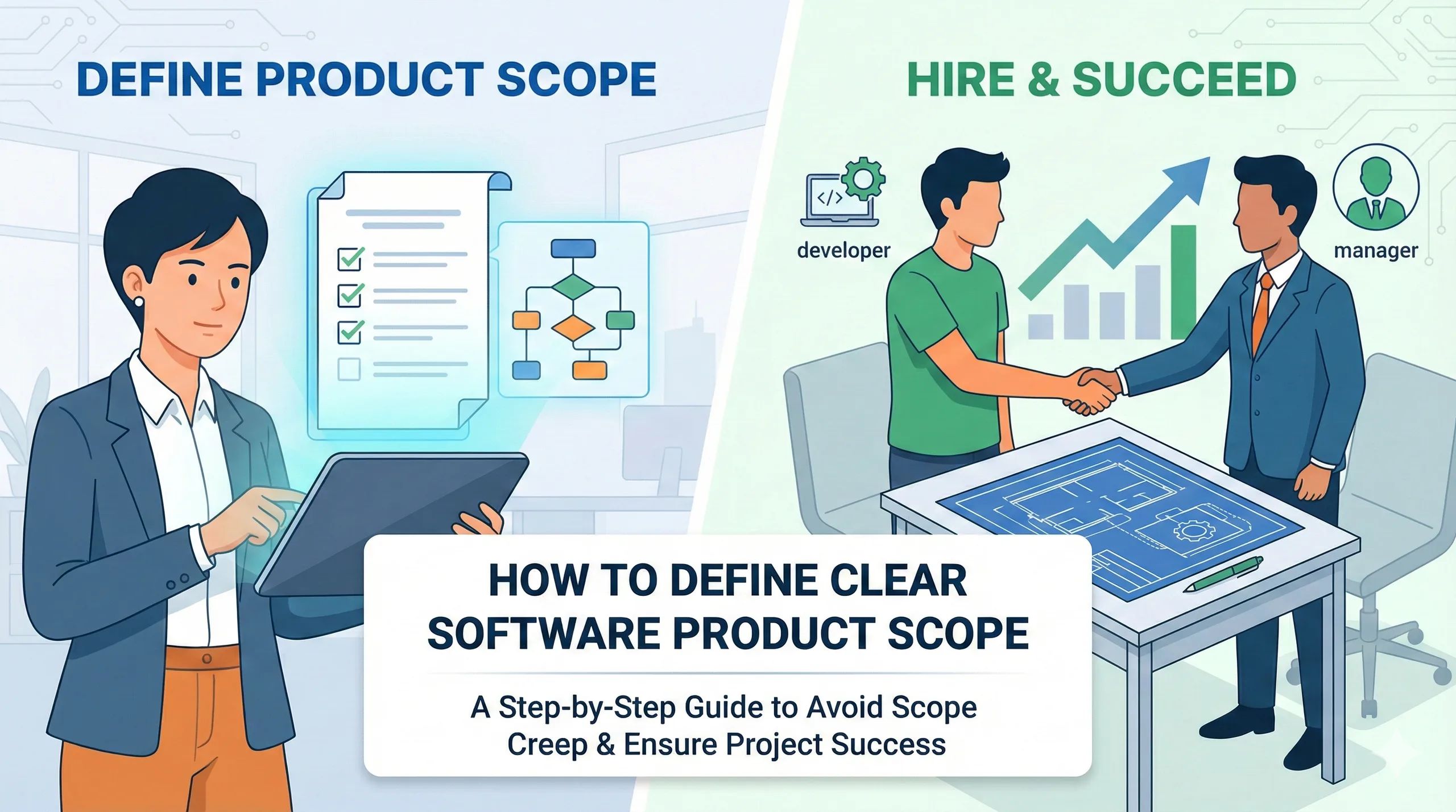
Business owners and product managers often rush into hiring developers without a clear software product scope. This leads to miscommunications, budget overruns, and failed projects. Defining scope upfront sets expectations and aligns teams for success.
A well defined product scope outlines what the software will deliver, its boundaries, and key features. It acts as a roadmap that developers and agencies can follow precisely. Studies show that projects with documented scopes finish 20 percent faster on average.
This guide walks through practical steps to create your scope document. Follow these to make informed hiring decisions and launch products efficiently.
Why Clear Product Scope Matters
Clear scope prevents scope creep, where uncontrolled changes inflate costs by up to 50 percent in software projects. It ensures developers focus on priorities, reducing rework and delays. Without it, agencies quote inaccurately, leading to disputes.
Defined scope improves communication between stakeholders and technical teams. Everyone understands goals, timelines, and deliverables from day one. This alignment boosts project success rates significantly.
For MSMEs and medical professionals building custom software, scope clarity minimizes risks. It helps evaluate developer proposals against exact needs, avoiding overpayment for unnecessary features.
Understand Product Scope vs Project Scope
Product scope describes the features, functions, and qualities of the final software. It answers what the product does for users. Project scope covers the work needed to build it, including tasks and resources.
Confusing these leads to bloated projects. Focus on product scope first: core functionalities like user login or data reporting. Project scope follows, detailing development phases.
Use this distinction in your document. Product scope drives business value; project scope manages execution.
Step 1: Identify Business Goals and Objectives
Start with why you need the software. List primary goals, such as streamlining patient records for clinics or automating inventory for retailers. Make them SMART: Specific, Measurable, Achievable, Relevant, Timebound.
Gather input from stakeholders via workshops or surveys. Prioritize goals that solve pain points. For example, a medical practice might aim to reduce appointment scheduling time by 40 percent.
Document objectives clearly. This foundation guides all scope decisions and helps developers align builds with business outcomes.
Step 2: Define Target Users and Their Needs
Profile your users: demographics, behaviors, pain points. For a healthcare app, target doctors, nurses, and patients. Map user journeys from login to key actions.
Conduct user interviews or analyze competitors. Identify musthave needs like secure data access or mobile compatibility. Avoid assuming; base on real insights.
Create user personas. Example: "Dr. Smith, 45yearold GP, needs quick chart access on mobile during rounds." This ensures scope reflects actual usage.
Step 3: List Core Features and Functionalities
Brainstorm features using MoSCoW method: Musthave, Shouldhave, Couldhave, Wont have. Musthaves form your MVP, like basic user authentication and dashboard.
Categorize by priority:
Musthave:User registration and loginCore data input forms Basic reporting
Shouldhave:Email notificationsAdmin panel
Couldhave:Advanced analytics
Wont have: AI predictions (phase 2)
Keep MVP lean: 5to10 key features maximum. This speeds development and validates ideas faster.
Step 4: Outline NonFunctional Requirements
Beyond features, specify performance, security, and usability. Examples:
Performance: Page loads under 3 seconds
Security: GDPR compliant encryption
Scalability: Handle 1000 concurrent users
Usability: Intuitive UI on desktop and mobile
For medical software, add HIPAA compliance and audit logs. These prevent costly postlaunch fixes.
| Requirement | Details | Priority |
|---|---|---|
| Security | SSL, JWT tokens | Must |
| Performance | <2s load time | Must |
| Accessibility | WCAG 2.1 compliant | Should |
Step 5: Set Boundaries and Exclusions
Explicitly state what is out of scope. This curbs expectations. Examples: No payment integration, no iOS app yet, no custom hardware support.
Define assumptions: Stable API from thirdparty services, client provides content. List constraints like budget under 50000 USD or timeline of 3 months.
Boundaries protect your project. Share them early with potential hires to filter mismatches.
Step 6: Create User Stories and Use Cases
Write user stories: As a [user], I want [feature] so that [benefit]. Example: As a clinic manager, I want appointment reminders so that no shows decrease.
Develop use cases for complex flows. Detail preconditions, steps, post conditions, exceptions. Tools like Lucid chart visualize these.
User stories bridge business needs and technical implementation. Developers use them for precise estimates.
Step 7: Prioritize with MVP Approach
Build Minimum Viable Product first: features delivering core value for launch. Test with users, iterate based on feedback.
Prioritization matrix:
| Effort | High Value | Low Value |
|---|---|---|
| Low | Quick Wins | Defer |
| High | Strategic | Avoid |
Launch MVP in 8-12 weeks. Full product follows in phases. This reduces risk for startups and MSMEs.
Step 8: Draft the Scope Document Template
Compile into a single document. Structure it as follows:
Business Objectives
User Personas
Features List (MoSCoW)
NonFunctional Requirements
Assumptions and ConstraintsTimeline and MilestonesSuccess Metrics (KPIs like 90 percent uptime)
Use free templates from Smartsheet or Google Docs. Version control it. Review with stakeholders for approval.
Share PDF with agencies during RFPs. It enables accurate quotes.
Common Mistakes to Avoid
Vague requirements cause 30 percent of project failures. Be specific: Not "fast app," but "95 percent queries under 1 second."
Skipping stakeholder buy in leads to midproject changes. Involve all early.
Ignoring technical feasibility. Consult experts briefly before finalizing.
Underestimating nonfunctional needs like security inflates costs later.
Rushing without MVP mindset builds unvalidated bloat.
Tools and Templates for Scope Definition
Leverage free tools:
Trello or Jira for feature prioritizationGoogle Docs for collaborative drafting
Figma for wireframes MoSCoW spreadsheets
Sample Scope Document Outline:
- Executive Summary
- Objectives
- Scope Inclusions/Exclusions
- Deliverables
- Timeline
- KPIs
These streamline your process.
How to Use Scope When Hiring Developers
Include scope in RFPs. Ask agencies to confirm understanding via questions or mockups.
Evaluate responses: Do they challenge unrealistic parts? Propose improvements?
Compare fixed price vs time materials bids against scope. Prefer those with discovery phases.
For freelancers, use scope for milestone payments. Clear scope attracts quality partners.
Real World Use Cases
A Dubai clinic defined scope for patient portal: MVP with appointments and records. Hired agency delivered in 10 weeks, cutting no shows by 35 percent.
Retail MSME scoped inventory app: Core tracking first. Post MVP added analytics. Stayed under budget.
These cases show scope drives ROI.
Integrating Scope with Agile Development
Even in agile, maintain scope baseline. Use it for sprint planning and backlog grooming.
Quarterly reviews adjust scope based on feedback, with change control process.
Agile with scope prevents drift while allowing flexibility.
Measuring Success Post Launch
Track KPIs: User adoption, bug rates, time to value.
Conduct retrospectives: Did scope match outcomes? Adjust for next projects.
Iterate: Scope evolves, but starts controlled.
Ready to Build Your Software Product?
Defining clear product scope positions you for successful development partnerships. TenG Spectrum specializes in turning scopes into high performing websites and apps. Contact us today for expert guidance on web development, SEO, or full digital strategy to bring your vision to life.
Frequently Asked Questions
Find quick answers to common questions about this topic